
Why Agentic AI Is Now the Hardest – and Most Valuable – Decision on Your Leadership Agenda?
Agentic AI has moved from concept to board-level agenda.


EXECUTIVE SUMMARY
Agentic AI has moved from concept to board-level agenda. Leading firms such as McKinsey, Bain & Company, and Accenture converge on the same message: value will come from agents that execute end-to-end workflows under tight governance, not from scattered copilots. The competitive window is narrowing as peers begin to institutionalize shared agent platforms, Human–Agentic Workforce models, and board-ready control frameworks championed by Deloitte, PwC, and Gartner. This brief distills cross-firm intelligence on platforms, workforce, business models, ROI, and sector use cases, and frames the decisions you need to orchestrate and de-risk over the next planning cycles.
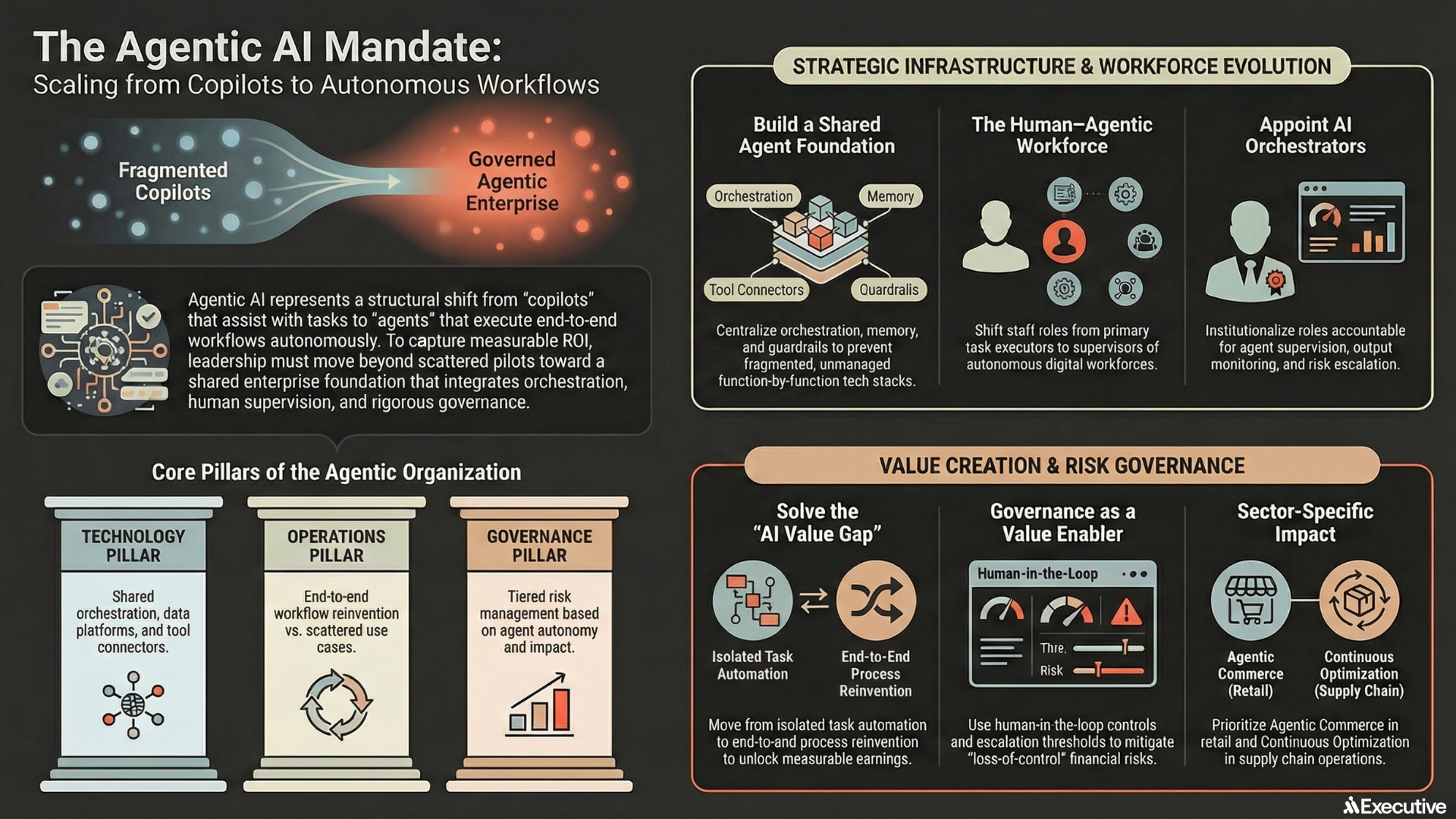
Table of Contents
- Technology Potential & Capabilities — Why shared agent platforms, orchestration, and data foundations are now strategic infrastructure for AI.
- Human Resources & Skills Development — How the Human–Agentic Workforce model rewrites roles, supervision, and leadership accountability.
- Business Model Transformation — How agentic organizations and platform strategies shift value creation, ecosystems, and governance.
- Investment & Return on Investment — How to reallocate AI budgets toward agentic workflows, with governance embedded as a value enabler.
- Industry Applications — How retail, supply chain, and public sector leaders are operationalizing agents to change service, cost, and speed.
- Cross-Article Synthesis — Where top firms align and diverge on agentic AI, and what this means for your sequencing of decisions and investments.
Technology Potential & Capabilities
Key Terms
Agentic AI / AI agents: AI systems that can plan, act, and coordinate across multiple steps and tools with some level of autonomy.
Multi-agent system: A set of specialized agents working together under shared rules, memory, and orchestration.
Orchestration layer: The control plane that routes tasks, manages tools, and enforces guardrails for agents.
Strategic Core
Across Bain & Company, Accenture, and KPMG, the core message is consistent: agentic AI is a structural technology shift, not a feature upgrade. Agents move beyond partial task automation to orchestrate complex, non-deterministic processes end-to-end. That requires a modern stack: orchestration, shared memory, tool ecosystems, and a robust data platform.
Executives should approach agentic AI as a foundational architecture and control capability—modernizing data, security, and governance to scale safely—rather than treating it as a one-off application rollout.
A key strategic choice is how quickly to standardize an enterprise agent foundation—shared orchestration, memory, connectors, and guardrails—so teams can innovate without creating unmanaged fragmentation.
Strategic Insights
Bain & Company argues that value rises when agents can reason over enterprise context, invoke APIs and tools, and coordinate across systems under a governed orchestration layer with clear controls and guardrails.
Accenture adds that networks of specialized agents, supported by shared memory and well-defined tool integrations, are emerging as a practical architectural pattern, with responsible AI embedded to keep execution safe and transparent.
KPMG frames agentic AI through a structured capability lens—reasoning, planning, workflow orchestration, governance/guardrails, and data mining—and ties these capabilities to measurable operational outcomes such as cycle-time reduction and stronger exception handling.
Together, they suggest a phased path from pilots to scaled deployment, while positioning the agent platform as a shared foundation that can be reused across functions with consistent controls.
Executive Takeaways
- Build an enterprise agent foundation with shared orchestration, interoperability standards, and governance/guardrails so agents can scale safely across systems—avoiding fragmented, function-by-function stacks.
- Establish a reference multi-agent architecture (roles, shared memory, tool integrations) and embed responsible-AI controls so new agent initiatives scale safely and transparently across the enterprise.
- Map priority processes to an agent capability taxonomy (planning, orchestration, guardrails) to target high-value pilots, then measure throughput and quality improvements with clear operational metrics as you scale.
Reflective question: How would a shared agent platform change the way your leadership team prioritizes technology and risk investments across business units?
Human Resources & Skills Development
Key Terms
Human–agentic workforce: A workforce where people and AI agents jointly execute work, with humans focusing on supervision, judgment, and exceptions.
AI supervisor / orchestrator: A role accountable for supervising multiple agents, monitoring outputs, and escalating risk events.
Strategic Core
Bain & Company, EY, and Deloitte converge on a simple but profound shift: people move from being primary task executors to supervising and orchestrating digital workforces of AI agents. As agents execute work at greater speed and scale, organizations should expect exception handling and accountability to shift—so workflows, governance, and decision-making responsibilities must be redesigned explicitly.
Executives should institutionalize new human–agentic roles (e.g., AI orchestrators), clarify decision rights and escalation paths between humans and agents, and evolve how performance is measured toward outcomes, quality, and effective oversight. Risk management responsibilities expand, particularly for those overseeing higher-impact agentic workflows.
Strategic Insights
EY calls for small expert teams managing large portfolios of risk-sensitive agents, supported by roles such as Head of Automated Risk Operations.
Deloitte positions the Human–Agentic Workforce as a structured transformation: redesign roles around outcomes, shift human oversight from execution to orchestration, and adopt a dual-speed approach that accelerates experimentation while building trust, governance, and alignment for enterprise-scale rollout.
Taken together, these perspectives emphasize upskilling and organizational readiness, a heavier governance and controls burden, and the need to define clear oversight models—how autonomy thresholds, human validation, and escalation paths will work as teams supervise more agents at greater speed and scale.
Executive Takeaways
- Redesign critical roles so people become AI supervisors rather than task executors, shifting from doing every task to providing oversight, judgment, and guardrails.
- Create named risk leadership roles for automated operations, with explicit accountability for agent behavior and escalation.
- Launch a Human–Agentic Workforce program that accelerates experimentation and learning while building trust, governance, and alignment, alongside outcome-based role redesign and organizational readiness.
Reflective question: If agents performed a growing share of routine decisions tomorrow, which roles in your organization would be under-defined or exposed from a risk perspective?
Business Model Transformation
Key Terms
Agentic organization: An enterprise where virtual and physical agents are embedded across the value chain, coordinated by a clear operating model and governance.
Platform strategy for agents: An approach where platforms, ecosystems, and APIs are designed assuming agents, not people, will be the primary users of many interfaces.
Strategic Core
McKinsey, Accenture, and Forrester stress that agentic AI is a business-model question as much as a technology one. Agents reshape how value is created and delivered—especially through AI-native customer channels—and push platforms to evolve into ecosystems that coordinate agents and continuously capture proprietary data to improve performance and economics.
Executives are pushed to decide where agents sit in the operating model, how platforms will expose capabilities to them, and how governance will scale as agents span multiple business units and external ecosystems.
Strategic Insights
McKinsey defines the agentic organization around five pillars—business model, operating model, governance, workforce/people/culture, and technology/data—drawing on lessons from early adopters.
Accenture outlines new rules for platform strategy in an agentic world, where aligning business–platform–AI strategy and embedding responsible AI into platforms and workflows can become direct levers for growth and adoption.
Forrester predicts enterprise software will move beyond enabling human employees to accommodating a digital workforce of AI agents, pushing leaders to rethink process digitization, orchestration, and governance.
Together, they signal that business and platform designs should move beyond human-centric assumptions—reworking workflows, interfaces, and governance so AI agents can operate safely at scale rather than being bolted onto existing designs.
Executive Takeaways
- Define an "agentic operating model" that clarifies where agents are embedded, who owns them, and how performance and risk are measured.
- Update platform and ecosystem strategy so core systems are ready for agent access, including identity, permissions, and usage governance.
- Stress-test software and service business models against a future where digital workforces become key users and buyers of capabilities.
Reflective question: If agents became primary users of your platforms, how would that change your revenue model, partner strategy, and governance expectations?
Investment & Return on Investment
Key Terms
Agentic AI advantage: The incremental value captured by shifting from isolated use cases to agents that manage entire workflows.
Loss-of-control risk: The risk that agents act outside intended boundaries, creating financial, operational, or compliance exposure.
Strategic Core
McKinsey, PwC, and Gartner focus on resolving the "AI value gap." Adoption is high, but impact is uneven. McKinsey frames a 'broad adoption with limited return' paradox, while PwC and Gartner emphasize the governance and risk controls needed to scale agents and sustain value.
A consistent message across the three is that agents deliver stronger impact when organizations move beyond isolated tasks toward end-to-end process reinvention—and pair that shift with robust, portfolio-level governance and controls.
For executives, the shift is from scattered pilots to a governed portfolio: prioritize a few end-to-end workflows, tier agent risk by autonomy and impact, define escalation and control mechanisms, and scale only after performance and compliance checks reduce loss-of-control exposure.
Strategic Insights
McKinsey highlights a paradox: widespread generative AI usage but limited measurable earnings impact. It argues that moving beyond isolated copilots toward agents embedded in end-to-end workflows can unlock more measurable impact—automating complex processes and creating new revenue opportunities.
PwC presents a responsible deployment model for AI agents, with human-in-the-loop controls, escalation thresholds, and performance and trust metrics to protect value.
Gartner warns that loss-of-control concerns will become dominant and that ethics, governance, and compliance must evolve to protect enterprise value.
Together, they position agents as a value lever that must be scaled with explicit governance and controls to capture upside while reducing loss-of-control exposure.
Executive Takeaways
- Shift from diffuse, horizontal copilots toward end-to-end workflow reinvention with agents at the core, defining outcomes upfront and using disciplined governance to turn pilots into measurable value.
- Institutionalize a responsible agent deployment framework with defined escalation thresholds, monitoring, and human oversight.
- Treat loss of control as a central scaling risk for agentic AI, and evolve AI ethics, governance, and compliance by extending existing governance frameworks across the current AI portfolio, with continuous monitoring, guardrails, and clear permissions.
Reflective question: How would your capital allocation change if you priced loss-of-control risk into every agentic AI investment alongside expected process and revenue gains?
Industry Applications
Key Terms
Agentic commerce: Commerce in which AI agents initiate, negotiate, or complete transactions on behalf of buyers or sellers.
Agentic operations: Operational environments where agents continuously monitor data and act within predefined guardrails to optimize performance.
Strategic Core
Bain & Company, EY, and PwC provide sector-level evidence that agentic AI is moving from theory into practical application in commerce and operations. Retail and supply chain examples show how agents can shift economics and service performance—through more automated transactions in commerce and faster, more cost-efficient operational decision-making within defined guardrails.
Executives should tie agent deployments to measurable outcomes and establish centralized systems and governance controls—monitoring, escalation paths, and human oversight—so agents can operate within domain-appropriate guardrails as adoption scales.
Strategic Insights
Bain & Company projects that agents could influence a meaningful share of e-commerce by 2030, reshaping how retailers and brands compete for demand and differentiate across the buying journey.
EY shows how agents can accelerate supply chain decisions, enable personalization without exploding costs, and support flexible operating models such as shared services.
PwC explains how the public sector can use agents to improve citizen services, education, and defense outcomes, provided foundations and governance are in place.
Together they illustrate that agentic AI is relevant across consumer, industrial, and government contexts.
Executive Takeaways
- Treat agents as a future channel in retail and customer-facing businesses, and plan for how they will influence demand and loyalty.
- Identify supply chain decisions that can be continuously optimized by agents, with clear service-level and cost metrics.
- Use public-sector playbooks as a model for complex, multi-stakeholder environments that require strong governance alongside efficiency.
Reflective question: Which of your core customer or operations journeys could benefit from agents that watch, decide, and act continuously within clear governance boundaries?
Cross-Article Strategic Synthesis
Strategic Consensus
Across McKinsey, Bain & Company, Accenture, Deloitte, PwC, EY, KPMG and Forrester, there is strong alignment on four points:
- Agents require a shared foundation: orchestration, data, and guardrails.
- Value comes from end-to-end workflows, not scattered tools.
- Workforce models must shift toward supervision and orchestration.
- Governance is integral to ROI, not an afterthought.
Consensus suggests executives should treat agentic AI as a multi-year operating model program with staged delivery and clear governance milestones.
Strategic Tensions
- Forrester places more emphasis on software vendors and digital workforce-centric business models, while McKinsey and PwC focus on enterprise-owned governance frameworks.
- Accenture and Bain & Company emphasize aggressive architectural modernization, whereas some public-sector guidance from PwC is more incremental and context-specific.
- Methodological note: Many studies rely on executive surveys, selected case studies, or modeled forecasts and may carry sector bias toward large incumbents. Few provide comparable cross-industry quantitative ROI; most evidence is directional. Executives should treat projections as scenario inputs, not precise forecasts, and adjust for sector regulation, data maturity, and culture.
Executive Reflection
As you consider your organization's readiness for agentic AI, which of these questions is most urgent for your leadership team to resolve in the next 90 days: How will we define our enterprise agent foundation? How will we redesign roles and accountability for human-agent collaboration? Or how will we balance innovation velocity with governance requirements?
Sources & References
Primary sources
- Bain & Company "Building the Foundation for Agentic AI" https://www.bain.com/insights/building-the-foundation-for-agentic-ai-technology-report-2025
- Accenture "Harnessing the Power of AI Agents" https://www.accenture.com/us-en/insights/data-ai/hive-mind-harnessing-power-ai-agents
- KPMG "Agentic AI Advantage: Unlocking Next-Level Value" https://kpmg.com/us/en/articles/2025/the-agentic-ai-advantage.html
- Bain & Company "What Is Agentic AI?" https://www.bain.com/insights/what-is-agentic-ai
- EY "Harnessing Agentic AI for Effective Risk Management" https://www.ey.com/en_au/insights/financial-services/emeia/what-risk-leaders-need-to-do-now-about-agentic-ai
- Deloitte "Agentic AI – Work, Reworked" https://www.deloitte.com/au/en/services/consulting/perspectives/human-agentic-workforce.html
- McKinsey & Company "The Agentic Organization: Contours of the Next Paradigm for the AI Era" https://www.mckinsey.com/capabilities/people-and-organizational-performance/our-insights/the-agentic-organization-contours-of-the-next-paradigm-for-the-ai-era
- Accenture "The New Rules of Platform Strategy in the Age of Agentic AI" https://www.accenture.com/content/dam/accenture/final/accenture-com/document-4/Accenture-The-New-Rules-of-Platform-Strategy-in-the-Age-of-Agentic-AI-Executive-Summary.pdf
Supplementary sources
- Forrester "Predictions 2026: AI Agents, Changing Business Models, and Workplace Culture" https://www.forrester.com/blogs/predictions-2026-ai-agents-changing-business-models-and-workplace-culture-impact-enterprise-software
- McKinsey & Company "Seizing the Agentic AI Advantage" https://www.mckinsey.com/capabilities/quantumblack/our-insights/seizing-the-agentic-ai-advantage
- PwC "Unlocking Value with AI Agents: A Responsible Approach" https://www.pwc.com/us/en/tech-effect/ai-analytics/responsible-ai-agents.html
- Gartner "AI's Next Frontier: Why Ethics, Governance and Compliance Must Evolve" https://www.gartner.com/en/articles/ai-ethics-governance-and-compliance
- Bain & Company "2030 Forecast: How Agentic AI Will Reshape US Retail" https://www.bain.com/insights/2030-forecast-how-agentic-ai-will-reshape-us-retail-snap-chart
- EY "How AI Agents Accelerate Supply Chain Transformation" https://www.ey.com/en_fi/how-ai-agents-accelerate-supply-chain-transformation
- PwC "Unlocking Tomorrow: Agentic AI for the Public Sector" https://www.pwc.com/gr/en/industries/government/agentic-ai-for-public-sector.html