
Why AI Sovereignty Is Becoming a CEO-Level Decision in a Multi-Model World?
AI sovereignty is rapidly becoming a CEO-level decision because it reshapes market access, operational risk, and vendor concentration exposure at the same time.


EXECUTIVE SUMMARY
The urgency is practical: decision windows are tightening as data residency expectations harden, buyers demand auditability, and model economics shift faster than most procurement cycles. This issue synthesizes consulting guidance into a single operating logic: institutionalize a multi-model strategy with explicit routing, fallback, and governance controls—so sovereignty becomes executable, not aspirational. You will see where leading firms align on “replaceable model layers” and lifecycle governance, where they diverge on partnership versus disconnected sovereignty, and what metrics executives can use to run the portfolio with discipline (cycle time, exception rates, QA pass, and cost per case).
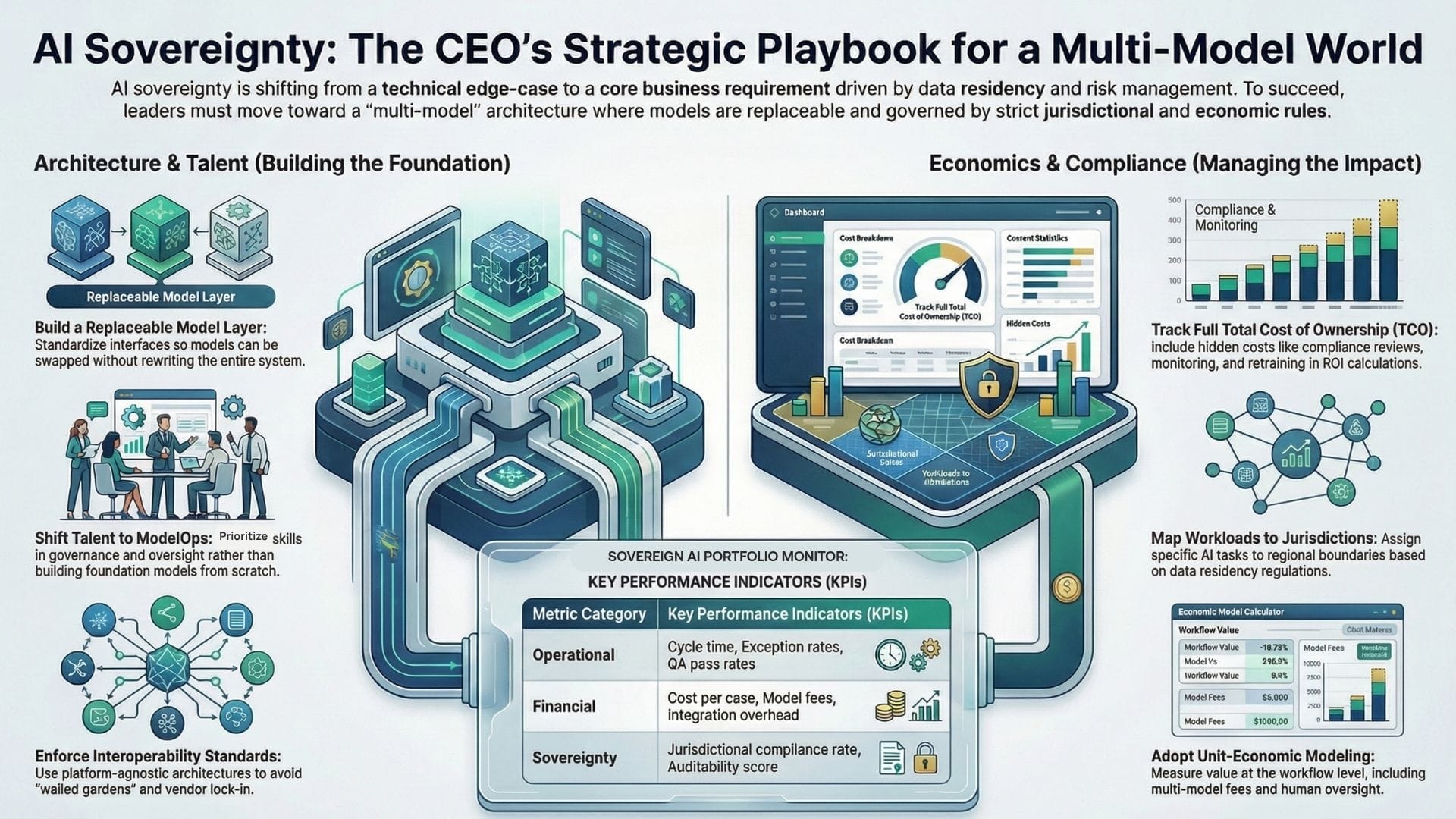
Table of Contents
- Technology Potential & Capabilities Build a replaceable model layer with routing rules and interoperability.
- Human Resources & Skills Development The minimum ModelOps capability set to supervise multiple vendors.
- Business Model Transformation How sovereign cloud models change market access and customer trust.
- Investment & Return on Investment True unit economics in a multi-model world, including governance overhead.
- Industry Applications Where sovereignty pressure shows up first and how to map workloads.
- Cross-Article Strategic Synthesis Consensus points, tensions, and measurement limits across firms.
Technology Potential & Capabilities
Multi-model strategy — Using more than one foundation model across workloads, with explicit routing, fallback, and governance rules.
Replaceable model layer — The architectural layer that standardizes how models are called, so any model can be slotted in or swapped without touching the rest of the system.
Sovereign AI — Keeping data, models, and compute within controlled boundaries to meet regulatory and risk requirements.
Interoperability — Standards and shared interfaces that allow tools, agents, and models to work across vendors, reducing switching friction.
Strategic Core
Model independence is now an architecture decision, not a procurement preference. The strategic move is to institutionalize a replaceable model layer: a portfolio of approved models with routing rules by sensitivity, latency, cost, and jurisdiction. This is the practical route to "sovereign-ready" operations—especially for organizations with cross-border customers, regulated data, or high brand-risk exposure.
The capability requirement is not "more AI." It is standardized interfaces, policy-driven routing, and strong monitoring.
Interoperability is the long-term unlock: it turns model choice into a controlled dial rather than a reinvention exercise each time the market shifts. (Forrester)
Strategic Insights
Two constraints drive the technology agenda: (1) sovereignty boundaries and (2) switching cost. Forrester notes agents are still "trapped in walled gardens," implying vendor-native stacks can silently harden into lock-in. Deloitte defines sovereign AI as controlled boundaries and explicitly ties it to reducing reliance on single providers.
The executive implication: treat interoperability, governance, and model orchestration as enterprise platform capabilities that scale across use cases and reduce vendor dependence.
- Define "controlled boundaries" for data, models, and compute—then align architecture and governance choices to those boundaries.
- Prioritize interoperability standards early so switching models becomes a governed change, not a platform rewrite.
- Adopt an open, platform-agnostic architecture so your AI stack can evolve with the broader ecosystem.
Where would a single-model dependency create a material operational or reputational failure if the vendor's terms, performance, or jurisdictional access changed?
Human Resources & Skills Development
ModelOps — The operating discipline for deploying, monitoring, governing, and improving models across their lifecycle: approvals, controls, documentation, monitoring.
Upskilling for vendor models — Training teams to manage and supervise vendor-licensed models safely, without building models from scratch.
Strategic Core
Multi-model and sovereign execution fails first on people, not platforms. The winning capability is a coordinated team that can run governance, monitor performance drift, manage approvals, and prove auditability across multiple models and jurisdictions.
EY is explicit: organizations cannot delay ModelOps as they scale. PwC reinforces the practical reality: most enterprises won't build foundation models—they'll supervise vendor models, shifting talent needs toward oversight, controls, and change management.
For executives, this is a workforce design decision: clarify team roles, invest in upskilling, and build consistent governance practices as AI scales.
Strategic Insights
The workforce needed to scale AI combines governance, technology, and operational oversight capabilities.
EY highlights that ModelOps skills often sit in "pockets" rather than unified teams, making governance harder as regulatory and accountability requirements increase. PwC frames upskilling as essential to "risk-managed outputs."
In practice, the skill premium is on governance, monitoring, exception handling, and human oversight: who approves model changes, how performance is monitored, and how teams intervene when risks or quality issues emerge.
- Stand up a ModelOps capability with clear lifecycle controls and documented approvals before multi-model AI scale accelerates.
- Upskill existing teams to supervise vendor models—governance, controls, and oversight skills matter more than building foundation models from scratch.
Do we have a named owner and trained team for model changes, monitoring, and escalation—or are we assuming the vendor will cover our risk?
Business Model Transformation
Sovereign cloud model — A deployment structure where operational control, data residency, and legal jurisdiction are designed into the cloud environment.
Architecture-first governance — Defining internal rules and extensibility before choosing vendor-native agents or models.
Strategic Core
Sovereignty is reshaping business models in three ways: where you can sell, how you operate, and what you can credibly promise customers.
BCG lays out distinct sovereign cloud models—up to fully disconnected setups—showing sovereignty is not a binary switch but a spectrum of control and connectivity. Forrester adds the organizational twist: leading teams are defining internal "plug-in" rules first, reducing vendor dependency later.
For C-suites, this is a business model strategy: sovereignty should be designed early because it shapes operating choices, partner models, and compliance readiness.
Strategic Insights
BCG is unusually practical: it provides clear partnership rules—objectives, partner selection, local expertise, audits, and monitoring—and shows that sovereign cloud implementation adds governance and coordination complexity, not just infrastructure work. This implies a hidden transformation cost: governance and operating cadence, not just infrastructure.
Forrester reframes the vendor conversation: instead of "which vendor," the better question is whether the organization has an internal architecture that any approved tool must meet. That's the mechanism that reduces vendor dependency and lowers switching risk over time.
- Choose a sovereign cloud model explicitly—connected vs disconnected—and codify partner roles, audits, and monitoring from day one.
- Institutionalize internal "plug-in" rules so vendors adapt to your architecture, not the reverse.
If sovereignty became a procurement requirement tomorrow, would our current operating model let us comply without freezing innovation?
Investment & Return on Investment
Unit economics (GenAI) — The real cost per AI outcome, including model fees, usage, multi-model interactions, and human oversight.
TCO (total cost of ownership) — Total lifecycle cost, including hidden governance and retraining overhead.
Strategic Core
Multi-model strategy is often justified as "risk reduction," but it also becomes a CFO-level ROI issue when costs and returns are measured rigorously. The financial objective is to make model choice a governed economic decision, balancing performance, usage, and oversight costs across GenAI use cases.
McKinsey warns that unit economics are complex precisely because multi-model interactions and oversight costs stack. Gartner reinforces that TCO frequently exceeds expectations due to hidden compliance and internal overhead.
Strategic Insights
The ROI trap is undercounting the "non-model" costs: compliance reviews, monitoring, retraining, and operational overhead.
Gartner explicitly calls out hidden TCO drivers and recommends tracking total costs. McKinsey goes further: when queries require multiple models, each carries its own fee—and human oversight remains a line item.
Fund multi-model ROI like a portfolio. Your measurement system must separate (a) model fees, (b) integration costs, (c) governance costs, and (d) productivity/value impact.
- Build a unit-economics model that includes multi-model fees, interactions, and oversight costs before scaling.
- Track full TCO—including compliance and overhead—and expand measurement beyond basic productivity metrics.
- Install spend-and-ROI tracking mechanisms tied to business process transformation and scale patterns.
Are we measuring AI value at the workflow level ($/case, cycle time, exception rate), or are we still tracking spend without a portfolio view of outcomes?
Industry Applications
Data residency — Rules requiring data storage and processing within specific geographic boundaries.
Auditability — The ability to demonstrate how outputs were produced, with logs and documentation that stand up to internal and external review.
Strategic Core
Industry pressure is converging on a common requirement: run AI in ways that meet regulatory boundaries, operational needs, and stakeholder expectations.
Deloitte provides a clear signal that sovereign AI is moving into mainstream planning—driven by data residency, in-region compute, and concerns over foreign-owned infrastructure dependence.
The practical playbook: identify which workloads must stay in-region, determine where local model hosting is mandatory, and align transparency, auditability, and documentation standards across markets. This is not future work—it is immediate operational readiness.
Strategic Insights
Deloitte reports strong planning signals: data residency and in-region compute rank as important to strategic planning for a large share of surveyed businesses, with significant concern about over-reliance on foreign-owned AI and compute.
Deloitte's recommended readiness actions are specific: map data and workloads to boundaries, set policies for cross-border flows and retraining, and align documentation and auditability standards across markets.
For executives, this is a near-term readiness issue: which workloads require sovereign deployment choices, and what documentation, transparency, and auditability standards must be met across markets.
- Map workloads to jurisdictional boundaries and codify auditability and documentation requirements early to strengthen compliance readiness.
- Use a build/buy/borrow decision tree to determine where sovereignty and ownership are non-negotiable versus where partnering de-risks deployment.
Which customer journeys or regulated processes would fail first if we could not run AI in the required jurisdiction tomorrow?
Cross-Article Strategic Synthesis
Strategic Consensus
- Sovereignty is rising from edge-case to baseline constraint—especially through data residency, in-region compute, and controlled deployment models. (BCG and Deloitte)
- Multi-model strategies only scale when supported by operating discipline—architecture rules, ModelOps, monitoring, auditability, and change governance. (Forrester and EY)
- ROI requires full-cost accounting—including multi-model fees, model interactions, compliance overhead, ongoing usage, retraining, and human oversight. (McKinsey and Gartner)
Strategic Tensions
Three key tensions define the decision landscape for executives navigating multi-model sovereignty:
- "Partner with hyperscalers" vs "disconnected sovereign stacks." BCG offers models across that spectrum; the tradeoff is speed and access to innovation versus maximum jurisdictional control.
- "Vendor ecosystem" vs "interoperability-first architecture." Forrester highlights missing standards; independence-by-design can be slower upfront but reduces long-term switching cost.
- Measurement limitations: Deloitte provides strong directional signals on sovereignty and governance, but they are context-sensitive; Gartner shows that ROI and TCO measures are often incomplete; McKinsey shows that even robust cost models depend on how enterprises allocate multi-model, usage, integration, and oversight costs.
Executive Reflection
As AI sovereignty shifts from a compliance checkbox to a strategic differentiator, the real question is not whether to act—but whether your organization has the architecture, talent, and governance structure to move before market or regulatory pressures force the decision.
Sources & References
Primary sources
- BCG "Sovereign Clouds Reshaping National Data Security" https://www.bcg.com/publications/2025/sovereign-clouds-reshaping-national-data-security
- Forrester "Rules in the Agentic Shipyard: Desired Agents Must Twist-Lock" https://www.forrester.com/blogs/rules-in-the-agentic-shipyard-desired-agents-must-twist-lock/
- Forrester "Interoperability Is Key to Unlocking Agentic AI's Future" https://www.forrester.com/blogs/interoperability-is-key-to-unlocking-agentic-ais-future/
- Deloitte "Agentic and Physical AI Set for Rapid Growth in Singapore" https://www.deloitte.com/southeast-asia/en/about/press-room/agentic-and-physical-ai-set-for-rapid-growth-in-singapore-in-the-next-two-years.html
- Gartner "Generative AI Topics & Insights" https://www.gartner.com/en/topics/generative-ai
- McKinsey & Company "What Matters Most: Eight CEO Priorities for 2024" https://www.mckinsey.com/capabilities/strategy-and-corporate-finance/our-insights/what-matters-most-eight-ceo-priorities-for-2024
Supplementary sources
- Deloitte "AI Adoption Challenges & AI Trends — Pulse Check Series" https://www.deloitte.com/us/en/what-we-do/capabilities/applied-artificial-intelligence/blogs/pulse-check-series-latest-ai-developments/ai-adoption-challenges-ai-trends.html
- PwC "Generative AI Impact on Business" https://www.pwc.com/us/en/tech-effect/ai-analytics/generative-ai-impact-on-business.html
- EY "ModelOps Frameworks Bridge AI Governance and Value" https://www.ey.com/en_us/insights/ai/modelops-frameworks-bridge-ai-governance-and-value
- KPMG "Agentic AI Untangled: Navigating the Build, Buy, or Borrow Decision" https://kpmg.com/kpmg-us/content/dam/kpmg/pdf/2026/25-19086-agentic-ai-untangled-navigating-the-build-buy-or-borrow.pdf
- PwC "Transform Through Generative AI" https://www.pwc.com/us/en/executive-leadership-hub/library/transform-through-generative-ai-pwc.html
All sources accessed Q4 2025 – Q1 2026.