Why Agentic AI Is the Operating System of the Next Enterprise
The operating model is the problem. Agentic AI is the structural solution, if you redesign before you deploy.


The operating model is the problem. Agentic AI is the structural solution — if you redesign before you deploy.
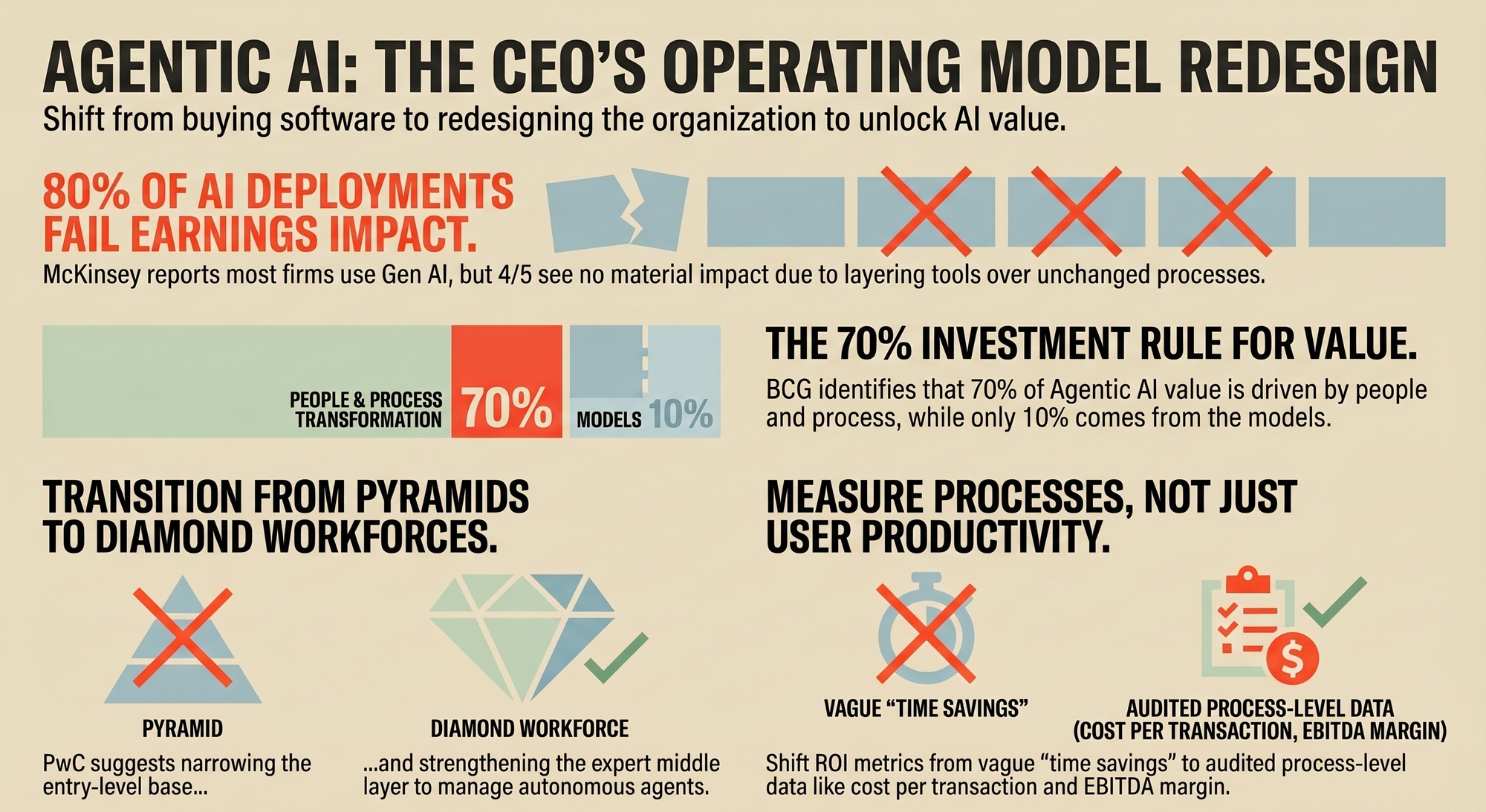
The most important statistic in enterprise technology right now is not a market size projection. It is this: 78% of companies that have deployed generative AI report no measurable earnings impact. That number, validated by McKinsey across thousands of organisations, is the diagnostic that explains why the transition to agentic AI is a structural inflection point, not a technology upgrade cycle. Generative AI was deployed as a tool layered onto unchanged processes. Agentic AI — autonomous AI systems that plan, reason, and execute multi-step tasks without human supervision — forces a different conversation entirely.
This issue synthesises intelligence from global advisory institutions: McKinsey, BCG, Bain & Company, Deloitte, PwC, Accenture, KPMG, Gartner, Forrester, and EY. The findings are more convergent than the consulting industry typically produces. Every firm agrees: the organisations generating 10–25% EBITDA gains from AI are not the ones with the best models. They are the ones that allocated 70% of their AI investment to people and process transformation, and treated AI agents as a new category of workforce — not a new category of software.
Three decision horizons define the next 90 days for your leadership team. First, an infrastructure audit. Second, a workforce position — has your CHRO applied BCG's six-role taxonomy to your top 20 job families? Third, a competitive window assessment: BCG's analysis of retail banking demonstrates that the compounding advantage from early agentic deployment cannot be replicated by licensing the same platform 24 months later.