
Why AI Agents Are Becoming Healthcare's New Operating Leverage Play
Revenue cycle, prior authorization, claims, and denials are becoming the first proving ground for agentic AI. The opportunity is measurable. The risk is governable only if leaders redesign the workflow before scaling autonomy.


Healthcare AI is entering a more consequential phase.
The near-term business case is no longer centered on speculative clinical transformation. It is emerging inside the administrative machinery that determines whether care is authorized, claims are paid, denials are appealed, and cash reaches the provider. Across leading consulting-firm research, a clear consensus is forming: AI agents are becoming a practical lever for revenue cycle management, prior authorization, coding, claims follow-up, utilization management, and patient-access operations. The opportunity is material, with consulting estimates pointing to significant reductions in cost to collect, cycle time, and manual rework. The decision window is narrowing. Executives now need to identify which workflows can be safely delegated, which require human oversight, and which controls must be in place before autonomy scales.
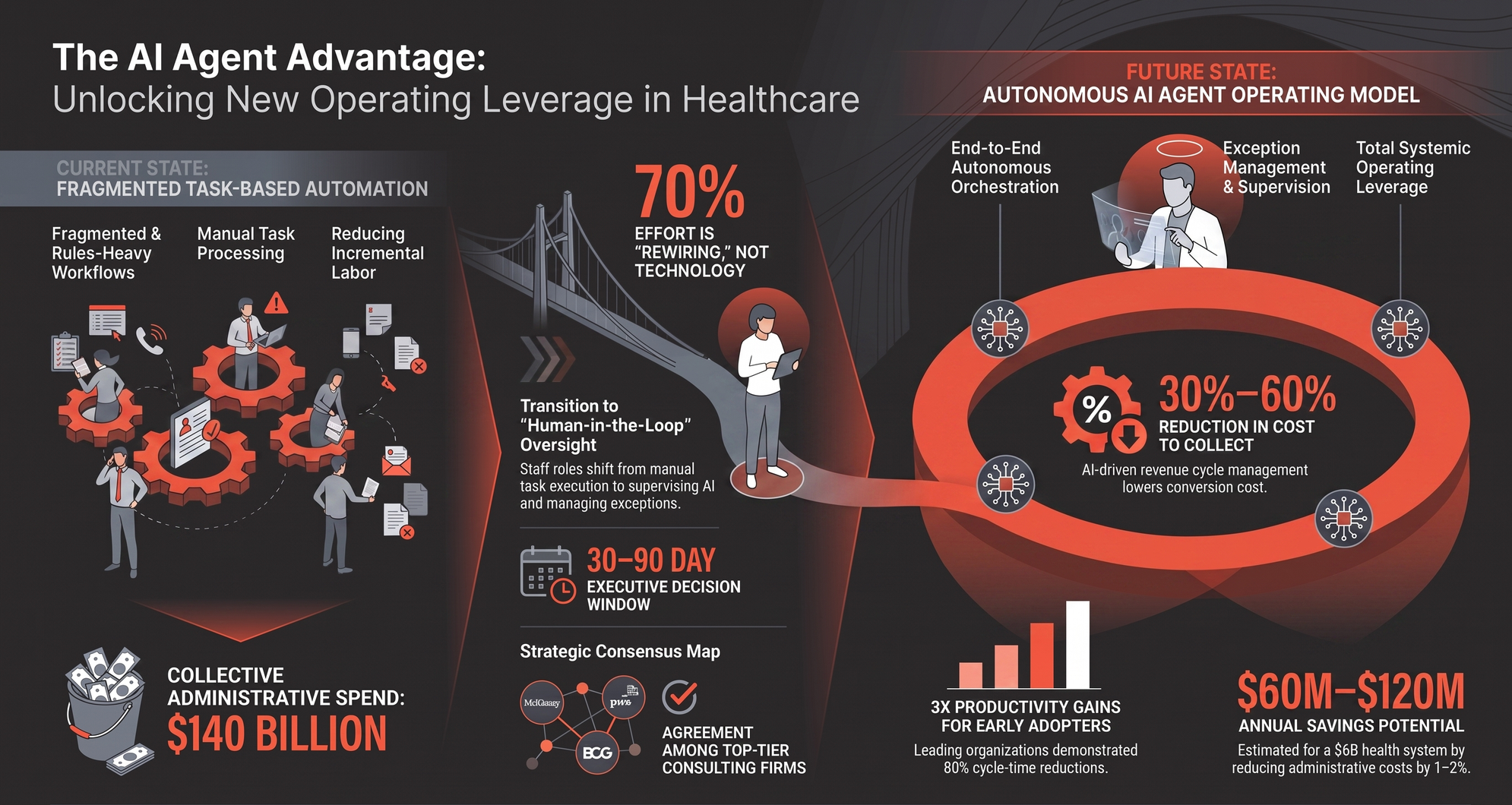
Table of Contents
- Technology Potential & Capabilities How AI agents are shifting from task assistance to governed workflow execution in healthcare administration.
- Workforce & Skills Development Why the workforce agenda is moving from manual processing to exception handling, quality review, and agent supervision.
- Business Model Transformation How AI agents could reshape payer-provider operations, administrative cost structures, and competitive positioning.
- Investment & Return on Investment Where executives should measure value: cost to collect, denial rates, clean-claim performance, A/R days, and authorization cycle time.
- Industry Applications Where AI agents are gaining traction first: revenue cycle, prior authorization, claims, denials, coding, patient access, and utilization management.
- Cross-Article Strategic Synthesis Consensus map and strategic tensions across the eight firms.
Technology Potential & Capabilities
How AI agents are shifting from task assistance to governed workflow execution across healthcare administration.
Agentic AI — AI systems that can execute multi-step tasks with limited human prompting. In healthcare administration, this means agents can review documents, route work, check rules, draft responses, escalate exceptions, and support end-to-end workflow execution — distinct from AI copilots that only advise or generate outputs on demand.
Strategic Core
AI agents are most credible in high-volume, rules-governed workflows with repeatable patterns and measurable outcomes — particularly where they can process structured data and documentation. Revenue cycle, denials management, prior authorization, eligibility checks, coding support, and claims follow-up fit this profile.
McKinsey frames agentic AI as a credible path toward a tech-enabled revenue cycle because it can execute complex processes, not only advise humans. In the next two to three years, leading health systems will move from pilots to production-scale deployments of agentic AI across the revenue cycle. PwC extends this view across patient access, clinical workflows, revenue cycle, back office, and enterprise intelligence — describing a blueprint for the agent-enabled provider enterprise in which each domain is rearchitected around agentic operating models, not augmented with point tools.
The executive implication is direct: automation strategy must move from task tools to governed workflow orchestration. AI agents that execute end-to-end administrative sequences — eligibility verification, prior authorization submission, denial routing, claims follow-up — require a different infrastructure layer than the copilots and point solutions deployed over the past two years.
Strategic Insights
The quantified opportunity is material. McKinsey estimates AI enablement of provider revenue cycle could reduce cost to collect by 30–60%, accelerate cash realization, and redirect staff toward higher-value work. Revenue cycle typically costs 3–4% of revenue for an at-scale health system, with US health systems collectively spending more than $140 billion annually on these processes. Nearly 20% of claims are denied on average, and as many as 60% of denied claims are never appealed — representing direct, recoverable revenue loss for the average health system.
PwC reinforces this capability shift by identifying eligibility, prior authorization, billing, and collections as high-value workflows suitable for holistic agentic automation. The strategic question is no longer whether AI can address these workflows — it is which workflows to prioritize, which controls to build in, and what governance must be in place before autonomous execution begins at scale.
- Prioritize high-volume, rules-based workflows with measurable operational and financial outcomes — particularly revenue cycle back-end processes — before expanding AI into patient-facing or clinical-adjacent activities.
- Design agentic AI around end-to-end workflow redesign rather than layering AI onto existing processes; the structural savings come from orchestrating complete sequences, not automating isolated tasks.
- Establish human oversight, escalation rights, and audit controls before autonomous workflow execution begins — governance must be built into the agent's runtime, not retrofitted after deployment.
How much of our current administrative cost base is caused by fragmented workflows and manual rework — and how much of that is addressable before we invest further in point-solution AI tools?
Workforce & Skills Development
Why the workforce agenda is moving from manual processing to exception handling, quality review, and agent supervision.
Human-in-the-loop — people retain oversight for exceptions, judgment calls, compliance-sensitive decisions, quality assurance, and escalation. In agentic workflows, humans move from task execution to supervision, exception management, and performance improvement — a structural shift in what healthcare administrative roles require.
Strategic Core
AI agents do not remove the need for people. They change the work people do.
McKinsey argues that staff responsibilities shift toward supervising AI-enabled workflows, handling exceptions, exercising judgment, and enabling patient-centered care. BCG makes the broader operating-model point: becoming AI-first is primarily a rewiring challenge, not a technology procurement exercise. BCG states that 70% of the effort in becoming an AI-first healthcare payer must go toward rewiring the organization, roles, talent, and processes — rather than technology itself.
For executives, the workforce challenge extends beyond staffing levels to redesigning capabilities, roles, governance, and human oversight across AI-enabled healthcare workflows. The risk of underfunding this dimension is not merely slower adoption — it is an operating model that produces autonomous AI outputs without adequate human review, creating compliance and patient-safety exposure.
Strategic Insights
The workforce implications are significant because value capture depends on adoption and operating-model change. BCG states that 70% of the effort in becoming an AI-first healthcare provider must go toward operational and organizational redesign — including workflow reimagination, role redesign, change management, and closing talent gaps. Technology and data account for only 20% of the total effort, and algorithms for 10%.
McKinsey notes that some providers are establishing AI centers of excellence bringing together product owners, development leads, data scientists, AI engineers, customer experience leads, and operations leads — a structure designed to govern, scale, and continuously improve AI deployment rather than treating it as a one-time implementation.
The strategic risk is underappreciated: reducing manual task volume without simultaneously redesigning roles for supervision and exception management weakens the operating model rather than strengthening it. Future quality assurance, compliance, and escalation depend on people who understand what the agents are doing — and that expertise must be deliberately built.
- Redesign roles around AI workflow supervision, exception handling, human judgment, and oversight of high-impact decisions — not just around the removal of manual tasks.
- Treat AI workforce transformation as an operating-model program, not a technology rollout; BCG's 70% principle means the majority of effort and investment must target people and processes.
- Establish an AI center of excellence that brings together product, data, operations, and clinical stakeholders to govern, scale, and continuously improve deployment — before the agent footprint grows beyond the organization's oversight capacity.
Which teams should stop doing repetitive administrative work and start supervising exceptions, controls, and patient-impact outcomes — and does our current talent development plan reflect that shift?
Business Model Transformation
How AI agents could reshape payer-provider operations, administrative cost structures, and competitive positioning.
AI-first operating model — redesigning processes, decision rights, data flows, governance, and roles so AI agents can coordinate work across functions. It is fundamentally different from adding AI tools to existing workflows. The distinction matters because tool-layer AI preserves the fragmentation that drives administrative cost; an AI-first model eliminates it by design.
Strategic Core
The strategic opportunity is larger than automation. It is the redesign of how healthcare organizations orchestrate administrative work — from fragmented, function-specific queues to intelligent, end-to-end workflows in which agents coordinate across systems, humans manage exceptions, and performance is tracked at the process level.
BCG argues that the value gap comes from leaving the "operating system of work" untouched. Organizations that drop AI tools into legacy workflows without redesigning the underlying processes capture incremental gains at best — and create compliance exposure at worst. Deloitte adds that many healthcare leaders are increasing investment in agentic AI, but returns depend on scaling beyond pilots. This creates a clear executive requirement: move from isolated use cases to an integrated operating model with workflow ownership, human oversight, governance, and measurable business outcomes.
Strategic Insights
The performance gap is stark. BCG reports that 60% of organizations have yet to capture material AI value at scale. In contrast, AI-future-built companies achieve three times the cost reductions and five times the revenue increases of laggards — a gap BCG attributes directly to whether organizations redesigned their operating models or simply deployed tools into unchanged workflows. The differentiator is not the technology — it is whether the workflow was rearchitected before the agent was deployed.
Deloitte reports that 61% of surveyed healthcare executives are already building or implementing agentic AI initiatives or have secured budgets, and 85% plan to increase investment over the next two to three years. The strategic implication is clear: competitive pressure is already materializing. Organizations still in pilot mode face a narrowing window before early adopters build compounding advantages in data, workflow knowledge, and institutional AI capability that cannot be replicated by procuring the same platform later.
- Redesign end-to-end processes before scaling agents across fragmented workflows — BCG's data shows the performance gap traces directly to whether the workflow was rearchitected, not whether the AI tool was deployed.
- Move beyond pilots by identifying the two or three workflows that should scale to enterprise-level deployment, and embed them within a governance framework that includes workflow ownership, human oversight, and outcome metrics.
- Treat process redesign as the primary investment, not the technology procurement decision; the 70% principle means that capital and leadership attention should concentrate on operating model change.
Are we deploying AI into old workflows and expecting different results — or redesigning the workflows from first principles so AI agents can safely create operating leverage?
Investment & Return on Investment
Where executives should measure value: cost to collect, denial rates, clean-claim performance, A/R days, and authorization cycle time.
Cost to collect — the cost required to convert patient services into collected revenue. In AI-enabled revenue cycle, it is a core CFO metric alongside denial rate, clean-claim rate, days in accounts receivable, exception rate, and appeal success rate. Process-level metrics of this kind are auditable and scalable in ways that user-level productivity proxies are not.
Strategic Core
EY frames AI-driven RCM as a way to reduce errors, minimize workflow friction, and convert work performed into cash more predictably. The CFO agenda should establish baseline metrics, track value through operational and financial KPIs, and measure outcomes before scaling AI across the revenue cycle.
McKinsey provides the clearest financial model: if a largely agentic AI back-end RCM solution could reduce a cost to collect of 3.5–4.0% by one to two percentage points, this translates to $60–120 million in savings for a health system with $6 billion in patient revenue. The value case is concrete, measurable, and scalable — provided process-level metrics are used rather than user-level proxies. Operational indicators such as initial denial rates, denial write-off rates, and accounts receivable days offer early signals of impact, even before full agentic deployment has been achieved across the revenue cycle back-end.
Strategic Insights
EY's CEO Outlook 2026 reports that 90% of chief executives expect AI to have a significant (58%) or transformative (32%) impact on their business model or operations within two years. Deloitte reports that 98% of surveyed healthcare executives expect at least 10% cost savings — with 37% projecting savings exceeding 20%.
Critically, measurement discipline separates organizations that realize ROI from those that do not. Denial write-off rates, A/R days, clean-claim rates, and authorization turnaround times are the process-level metrics that make the AI investment case auditable at the board level. User-level time savings are directionally useful but not sufficient for capital allocation decisions. Executives who build the measurement framework before scaling deployment are in a materially stronger position to govern the investment and defend it to the board.
- Measure AI value through cost to collect, denial rates, A/R days, and revenue cycle performance metrics before expanding deployment — these are the process-level KPIs that are auditable and scalable, unlike user-level proxies.
- Position AI-driven revenue cycle management as a financial resilience strategy, not a cost-cutting program; the savings improve cash performance and operational efficiency simultaneously, with a measurable impact on CFO metrics.
- Prioritize agentic AI investments that demonstrate a clear path from pilot to enterprise-scale value using auditable process-level metrics — executives who build the measurement framework before deployment make the governance case defensible at the board level.
Which AI investments can be measured through cash, cycle time, exception rate, and patient-access outcomes within one operating cycle — and which are we still measuring through activity proxies that cannot sustain board-level scrutiny?
Industry Applications
Where AI agents are gaining traction first: revenue cycle, prior authorization, claims, denials, coding, and utilization management.
Prior authorization automation — AI-enabled workflows that prepare, check, submit, monitor, and escalate authorization requests. It can reduce manual burden, shorten turnaround time, and reduce authorization-related denials — but it must preserve auditability, appeal rights, and human oversight for access-sensitive decisions. Governance is not optional in this workflow; it is the condition for safe deployment.
Strategic Core
The strongest industry applications are emerging across provider RCM, payer utilization management, claims, prior authorization, coding, and patient financial communications. Bain & Company reports that revenue cycle management has returned as a high investment priority for providers, while payers emphasize utilization and network management. Private equity investment and technology partnerships have amplified this signal, with recent activity targeting AI-powered agentic applications across revenue cycle operations.
Forrester's analysis of HIMSS 2026 observed that conversations shifted from AI copilots to autonomous execution: revenue-cycle leaders gravitated toward agentic AI platforms positioned to manage denials, coding, and appeals with limited human intervention. Governance and security emerged as the true scaling constraints — with concerns surfacing around accountability, non-human identity management, and post-deployment monitoring.
Gartner provides an important counterbalance: market interest is high, but enterprise deployment and operational maturity remain in the early stages. Only 17% of organizations have deployed AI agents, even as more than 60% expect to do so within two years — the most aggressive adoption intent curve the firm has recorded for any emerging technology category. High enthusiasm must not be mistaken for enterprise readiness.
Strategic Insights
Bain & Company states that RCM has become a high-priority investment because AI improves documentation quality, coding accuracy, cleaner claims, fewer denials, and prior authorization throughput — creating measurable financial value that is defensible in ROI terms. The 2025 Bain/KLAS survey of 228 US healthcare provider and payer executives finds that 70% of providers and 80% of payers now have an AI strategy in place or in development, up from 60% for both groups the prior year.
Forrester notes that prior authorization, payment integrity, and patient financial communications are among the leading agentic AI use cases for their operational and business value. Governance emerged as the dominant scaling constraint — accountability, non-human identity management, and post-deployment monitoring were frequently cited concerns that vendors had not clearly addressed in HIMSS presentations.
Gartner reports that only 17% of organizations have deployed AI agents, while more than 60% expect to do so within two years. The firms most likely to succeed are those starting with bounded use cases, investing in production observability before deploying at scale, and building the governance layer in parallel with the deployment layer — not as a retrofit.
- Prioritize RCM use cases where better documentation, cleaner claims, fewer denials, and stronger coding accuracy deliver measurable financial value — and sequence deployment starting from the back-end of the revenue cycle where risk is lower and ROI is fastest.
- Build governance, identity management, and post-deployment monitoring into every agentic AI deployment before scaling; Forrester's HIMSS 2026 analysis shows that governance gaps — not technology gaps — are the primary scaling constraint.
- Balance strong market intent with operational maturity; Gartner's 17% current deployment rate against 60%+ adoption intent signals a market at the Peak of Inflated Expectations — where early enthusiasm must be grounded in disciplined execution to avoid becoming part of the failure statistics.
Where can AI agents improve our financial performance without weakening patient trust, compliance controls, or clinical accountability — and do we have the governance infrastructure to enforce those boundaries at scale?
Cross-Article Strategic Synthesis
Where the eight firms agree — and where they sharply diverge.
Strategic Consensus Map
Three points of structural agreement across all eight firms:
- Administrative workflows are the right starting point. McKinsey, PwC, EY, Bain & Company, and Forrester all point to revenue cycle, prior authorization, denials, coding, claims, and back-office workflows as near-term AI-agent opportunities. The shared recommendation is practical: start with measurable, rules-governed workflows, prove value at the process level, and scale under governance. (McKinsey and PwC)
- AI value depends on process redesign, not tool procurement. BCG argues that organizations capturing material value redesign end-to-end processes for agentic AI. Deloitte's data shows investment surging — 61% already building, 85% increasing spend — yet returns depend on operating model change, not deployment volume. (BCG and Deloitte)
- Measurement discipline is the differentiator. The most relevant KPIs are cost to collect, denial rate, denial write-off rate, clean-claim rate, A/R days, authorization turnaround time, exception rate, and staff capacity. McKinsey and EY both anchor the investment case in process-level financial metrics — not user-level productivity proxies. (McKinsey and EY)
Strategic Tensions
Where the firms diverge — and what that divergence means for executive decision-making:
- "Move decisively" vs. "Execution precedes enthusiasm." McKinsey, Deloitte, and BCG encourage executives to move decisively because the value pool is large and adoption intent is surging. Gartner provides the counterweight: only 17% of organizations have deployed agents, even though more than 60% expect to within two years — and Gartner predicts over 40% of agentic AI projects will be cancelled by 2027 due to governance failures, unclear business value, or cost overruns.
- "Financial resilience" vs. "Competitive-model disruption." EY and Bain & Company emphasize ROI, cleaner claims, and near-term financial resilience. BCG pushes the strategic aperture wider, warning that AI-first competitors — potentially including technology firms entering healthcare administration — may compete selectively in high-value payer and provider segments, forcing incumbents to rethink where they play and what their cost structure must look like.
- Evidence quality caveat: Most sources provide strong directional evidence, but methodological limitations apply. Survey data from Deloitte captures executive expectations, not audited outcomes. McKinsey provides estimates and modeled savings potential, not universal realized savings. Forrester reports conference signals, which are useful but may overrepresent vendor-forward narratives. Gartner reinforces the caution: high market attention may significantly exceed operational maturity.
Executive Reflection
Where should your organization allow AI to execute work, where should it only assist, and where must human judgment remain non-negotiable — and does your current governance infrastructure enforce those distinctions, or does it assume they will be respected by default?
Sources & References
Primary sources
- McKinsey & Company — "Agentic AI and the Race to a Touchless Revenue Cycle · Jan 2026" https://www.mckinsey.com/industries/healthcare/our-insights/agentic-ai-and-the-race-to-a-touchless-revenue-cycle
- BCG — "AI for Healthcare Payers · 2026" https://www.bcg.com/publications/2026/ai-for-healthcare-payers
- BCG — "Transforming to an AI-First Health Care Provider · Apr 2026" https://www.bcg.com/publications/2026/transforming-to-an-ai-first-health-care-provider
- Bain & Company — "Healthcare IT Investment: AI Moves from Pilot to Production · Oct 2025" https://www.bain.com/insights/healthcare-it-investment-ai-moves-from-pilot-to-production/
- Deloitte Insights — "Many Health Care Leaders Are Leaning into Agentic AI · 2026" https://www.deloitte.com/us/en/insights/industry/health-care/agentic-ai-health-care-operating-model-change.html
- PwC — "Reimagining Healthcare with Agentic AI (with AWS & Anthropic) · 2026" https://www.pwc.com/us/en/technology/alliances/library/reimagining-healthcare-agentic-ai-aws-anthropic.html
- EY — "AI Transformation: Seven-Layer Blueprint for ROI · 2026" https://www.ey.com/en_us/insights/ai/ai-transformation-seven-layer-blueprint-for-roi
- EY — "CEO Outlook 2026: AI, Transformation and Growth · Jan 2026" https://www.ey.com/en_gl/ceo/ceo-outlook-global-report
Supplementary sources
- Forrester — "HIMSS26: A Shift from AI Optimism to Operational Reckoning · Mar 2026" https://www.forrester.com/blogs/himss26-a-shift-from-ai-optimism-to-operational-reckoning/
- Forrester — "Agentic AI in Healthcare: A New Era of Intelligent Automation · Jul 2025" https://www.forrester.com/blogs/agentic-ai-in-healthcare-a-new-era-of-intelligent-automation/
- Gartner — "2026 Hype Cycle for Agentic AI · Apr 2026" https://www.gartner.com/en/articles/hype-cycle-for-agentic-ai