
Why Is AI Investment Still Failing to Reach the P&L?
AI investment is moving into a more demanding phase. Access is broad. Adoption is increasing. The harder task is institutionalizing the disciplines that convert capability into value.


Adoption is no longer the question. Converting operational improvement into finance-validated value is.
AI investment has entered a new phase of executive accountability. Adoption is increasing, budgets are expanding and productivity evidence is emerging. Yet measurable financial returns remain concentrated among a small group of organizations. The constraint is no longer access to technology. It is the ability to convert operational improvement into revenue, cost reduction, capacity or risk outcomes that finance can validate. Research from McKinsey & Company, Accenture, PwC, Gartner, KPMG and Forrester points to the same executive imperative: institutionalize value ownership, redesign material workflows and audit the full path from AI deployment to P&L impact. The organizations that act within the next planning cycle will be better positioned to scale proven use cases, de-risk capital allocation and avoid carrying an expanding portfolio of activity without economic evidence.
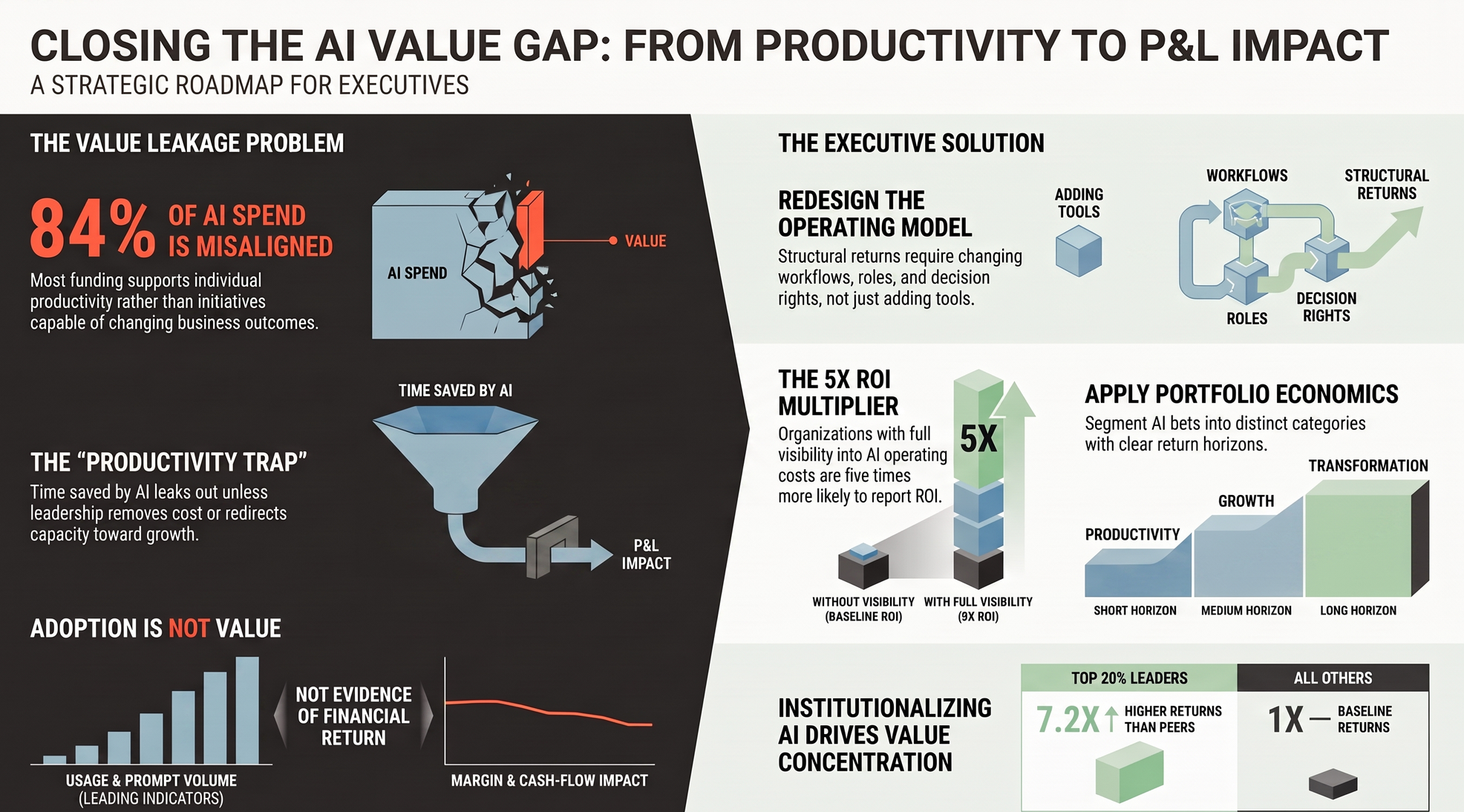
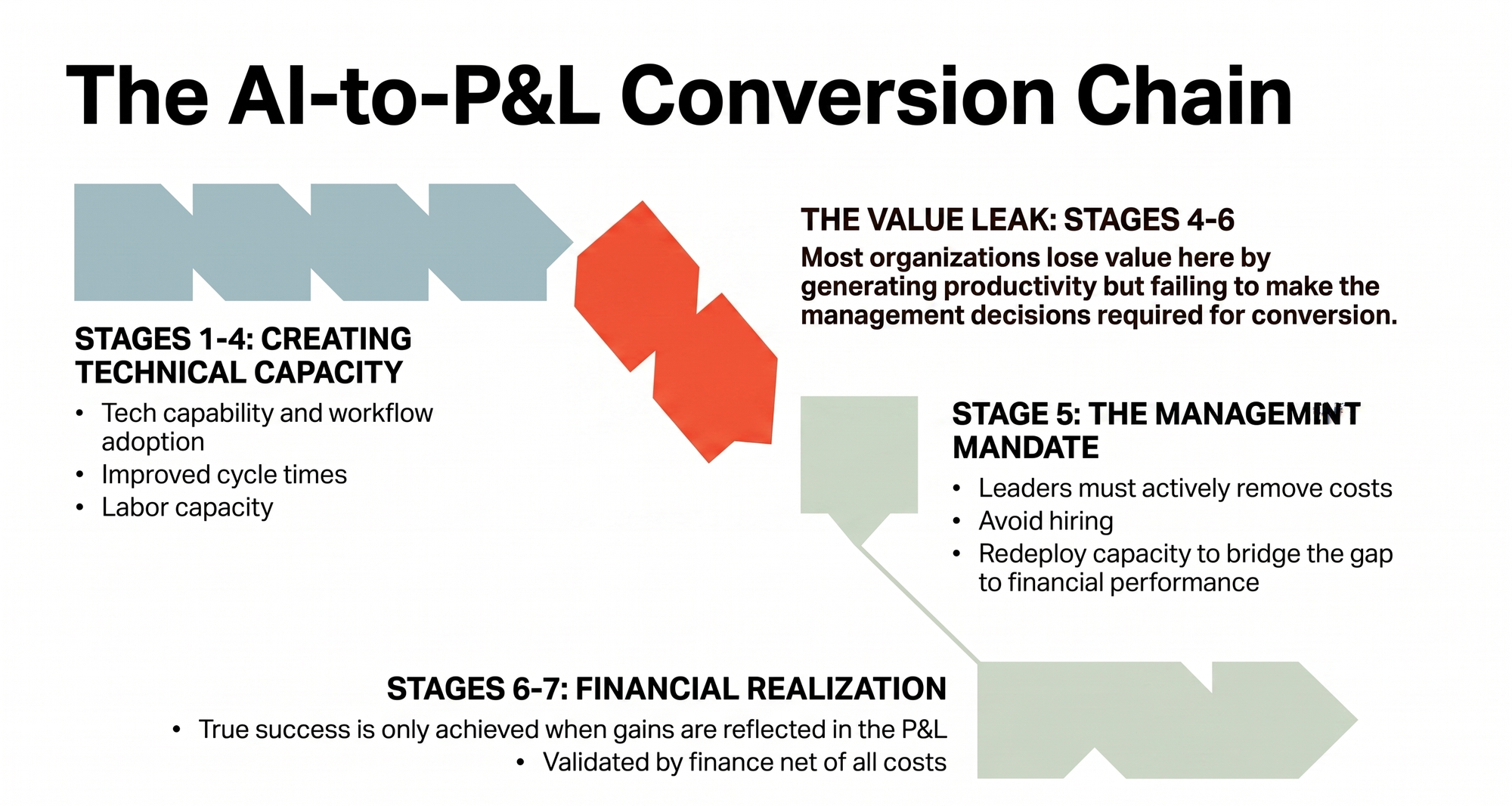
Table of Contents
- Technology Potential and Capabilities Why technology maturity is no longer the main constraint — and what determines whether AI produces enterprise value.
- Human Resources and Skills Development How to convert employee time savings into cost, capacity or revenue instead of leaving it trapped.
- Business Model Transformation Why generic efficiency gains will not create a durable moat — and what will.
- Investment and Return on Investment How CFOs should segment AI investments by value thesis, return horizon and evidence standard.
- Industry Applications: Financial Services and Insurance Connecting AI initiatives to process-level measures banks and insurers can actually audit.
- Cross-Article Strategic Synthesis Consensus map and strategic tensions across the six firms.
Technology Potential and Capabilities
Technology maturity is no longer the main constraint — enterprise execution is.
AI value realization — The process of converting AI capabilities into verified operational improvements and, ultimately, measurable financial or strategic outcomes. It is distinct from AI adoption, which only shows that a system is available or being used.
Strategic Core
AI technology is increasingly capable. Enterprise execution is the constraint.
McKinsey & Company argues that leading organizations are redesigning how work is performed and how decisions are made, rather than placing AI inside unchanged processes. Gartner similarly finds that finance functions continue to direct most AI spending toward individual productivity and process-improvement use cases rather than initiatives capable of materially changing business outcomes.
The implication is clear: isolated tools may accelerate tasks, but material enterprise value depends on redesigning workflows and the operating systems around them to improve cost, throughput, decision speed or growth outcomes.
Strategic Insights
Within finance, AI spending remains heavily weighted toward individual productivity and process improvement rather than enterprise-level value creation. According to Gartner, 84% of finance AI spending supports individual productivity and process-improvement use cases, while only 16% supports initiatives capable of materially changing business outcomes.
KPMG adds an important economic control: organizations with full visibility into AI operating costs are five times more likely to report established ROI, at 15% versus 3%.
Enterprise AI value realization therefore depends on cost transparency, connected systems and clear accountability — not model capability alone.
- Select a limited number of high-value workflows and redesign them end to end before expanding the technology portfolio.
- Rebalance AI funding away from fragmented productivity tools toward scalable capabilities that can change business outcomes.
- Institutionalize visibility into AI costs, usage and value, supported by monitoring, cost controls and clear accountability.
Human Resources and Skills Development
Productivity does not reach the P&L until management decides what happens to released capacity.
Capacity conversion — The management process that turns employee time saved through AI into a defined business outcome, such as lower cost, avoided hiring, higher throughput, improved service or additional revenue.
Strategic Core
Workforce productivity does not reach the P&L automatically. PwC finds that financial-services firms often observe adoption and productivity before they can identify revenue or cost effects.
Management must decide what happens to released capacity. Released capacity can be redirected toward training, higher-value work, stronger customer relationships or growing areas of the business. Without a deliberate strategy, released time — and the value of that time — may simply leak out.
Leaders must therefore integrate AI investment with workforce planning, organizational and workflow redesign, skills development and financial measurement.
Strategic Insights
In PwC's 2026 Financial Services Workforce AI Survey of 1,004 US executives, 77% said most AI investments were not delivering measurable ROI. The report recommends tracking adoption and productivity as leading indicators before expecting lagging financial results.
Skills are also becoming more economically important: separate PwC research found that roles requiring AI skills now carry an average wage premium of 62%, while postings for those roles grew 69% against 9% for the market as a whole.
This creates a dual requirement for executives: build and fund the skills needed to scale AI while applying financial rigor to workforce and AI investment decisions.
- Require every productivity claim to specify how released capacity will be reallocated and translated into financial value.
- Prioritize role-specific AI training and build AI-fluent leaders across the workforce — not only technical specialists.
- Establish clear accountability, strong governance and cost visibility to turn AI adoption into measurable business value.
Business Model Transformation
Generic efficiency gains will not create a durable moat — returns are concentrating in a small cohort.
AI-enabled operating model — How strategy, workflows, people, data, technology, governance and decision rights work together to produce repeatable business outcomes from AI.
Strategic Core
The most durable AI advantage is unlikely to come from generic productivity tools that competitors can also acquire. It will come from changing how the institution creates, delivers and captures value.
McKinsey & Company argues that organizations must use broadly available technology to build capabilities competitors cannot easily reproduce. PwC reinforces this view by finding that AI leaders focus on growth as well as efficiency.
For banks and insurers, this can include reducing customer-journey friction, scaling core workflows, launching new products more efficiently and pursuing new sources of growth.
Strategic Insights
PwC found that the top 20% of 1,217 surveyed companies captured 74% of AI-driven returns. These organizations generated AI-related financial performance 7.2 times higher than other respondents.
The concentration suggests that value is not distributed evenly among adopters. It accrues to organizations that coordinate strategy, data, investment, workforce, governance and innovation.
The evidence also supports a strategic distinction: efficiency can reduce costs, while redesigned workflows, stronger customer experiences and business-model reinvention can unlock growth and higher-value outcomes.
- Balance efficiency initiatives with a smaller portfolio of growth-oriented use cases tied to customer acquisition, retention or product economics.
- Build defensibility through proprietary data, embedded workflows and organizational learning rather than model access.
- Treat AI as a business reinvention agenda that combines technology, work redesign and workforce transformation to deliver enterprise-wide value (Accenture).
Investment and Return on Investment
Not every AI initiative should be judged by the same formula — or on the same horizon.
AI portfolio economics — The practice of evaluating AI initiatives as different investment classes, with distinct objectives, risks, evidence standards and return horizons, rather than applying one ROI formula to every use case.
Strategic Core
Executives need stronger financial discipline, but not every AI initiative should be judged identically. Gartner recommends treating AI as a portfolio of different bets.
Productivity and automation use cases can be assessed through cost, efficiency and productivity outcomes. Growth-oriented use cases should be evaluated against the revenue and customer outcomes they are designed to create. Transformational investments require different targets, timelines and risk expectations, with weak bets stopped early and stronger ones scaled.
Forrester reinforces this approach by showing that conventional measurement often fails to capture AI's different financial, operational and strategic value mechanisms while still requiring defensible executive evidence.
Strategic Insights
The value gap is visible across multiple surveys. PwC found that 30% of CEOs reported AI-related revenue gains and 26% reported lower costs, while 56% had realized neither outcome and only 12% had realized both.
KPMG reported that many leaders see meaningful business value from AI, while only 7% can point to established ROI — and 24% are already facing investor pressure to demonstrate it.
These results are not directly comparable because the samples and definitions differ. Together, the surveys show that reported business value and measurable financial returns are distinct — and should not be treated as equivalent.
- Segment the AI portfolio across productivity, targeted process improvement and selective transformational bets, each with distinct economics and timelines.
- Use a shared value framework combining financial outcomes with productivity, engagement and strategic value, with targets and timelines by value type.
- Separate realized benefits from established ROI and track both as distinct measures of AI value realization.
- Move beyond isolated tactical projects by scaling AI initiatives aligned with business strategy and supported by strong enterprise foundations.
Industry Applications: Financial Services and Insurance
Measure AI through realized operational and financial outcomes — not deployment volume.
Process-level value metric — A measure connecting an AI use case to the operating performance of a specific workflow. Examples include straight-through-processing rate, cycle time, exception rate, quality-assurance pass rate, conversion rate and cost per case.
Strategic Core
Financial institutions should measure AI through realized operational and financial outcomes — not deployment volume. In banking and insurance, AI value should be demonstrated through measurable improvements in the business workflows where AI is deployed.
In finance operations, leaders should assess whether AI improves close and forecasting processes, execution speed and decision quality.
PwC and Gartner both emphasize that deployment only matters when it produces measurable operational or enterprise value.
Strategic Insights
Financial-services organizations are investing heavily, but evidence remains uneven. PwC found that 80% of financial-services respondents are scaling AI enterprise-wide or have fully embedded it across business units — the highest of any industry surveyed — while its AI Agent Survey found customer service, sales and marketing, and IT and cybersecurity among the leading application areas.
Gartner found that nearly 60% of CFOs planned to increase finance AI investment by at least 10%, while efficiency remained a dominant objective — staff productivity is a top-three priority for 88% of them.
The sector opportunity is substantial, but productivity gains should be connected to measurable process, financial and strategic outcomes, alongside financial-services risk and control considerations.
- Connect workforce productivity to financial outcomes, customer experience and new revenue opportunities, with a clear plan for released capacity.
- Replace deployment volume with measures of improved decisions, faster execution and stronger influence on enterprise outcomes.
- Build AI economics around cost visibility, governance, clear decision rights and human-intervention rules to support measurable returns.
- Build a continuous performance loop around clear KPIs, real-time data and performance management to sustain operational and financial value.
Cross-Article Strategic Synthesis
Where the six firms agree — and where the trade-offs remain unresolved.
Strategic Consensus Map
The selected firms align around five conclusions:
- AI adoption is not evidence of financial value. Usage, prompt volume, licenses and deployed tools are leading indicators. They do not demonstrate revenue, margin, cash-flow, risk or capital effects. (Accenture, KPMG, PwC and Forrester all identify a gap between activity and defensible returns.)
- Operating-model redesign is the principal value multiplier. Incremental tools can improve tasks; structural value requires changes to the complete process and the surrounding management system. (McKinsey and Accenture place workflow design, ownership and operational discipline at the centre of AI performance.)
- Finance must validate — but not narrowly define — AI value. Gartner recommends different return models for different investment types; Forrester argues that existing measurement can overlook customer, operational and strategic benefits. The consensus is not to weaken financial discipline, but to use the right evidence for each value thesis.
- Cost visibility and governance support ROI. KPMG reports a strong association between visibility into operating costs and established ROI. Governance, monitoring, human oversight and auditability should therefore be treated as part of investment economics — not as external compliance overhead.
- Growth creates more differentiation than productivity alone. Generic efficiency gains will diffuse across the market. Durable advantage is more likely to emerge through proprietary workflows, better customer outcomes, new products and changed business models. (PwC and McKinsey.)
Strategic Tensions
Where the research diverges, and what that divergence means for executive decision-making:
- "Near-term ROI" vs "long-term transformation." CFOs require evidence within practical planning horizons, while transformational AI investments may need longer to mature. Gartner's portfolio approach provides a workable compromise: retain staged funding, explicit milestones and termination criteria, but use different return horizons for automation, growth and strategic capability.
- "Efficiency" vs "growth." Efficiency benefits are easier to isolate and validate; growth is harder to attribute because market conditions, pricing, channel activity and sales behaviour also affect revenue. PwC places greater emphasis on growth, while Gartner and many finance-focused publications begin with productivity and process outcomes. The strongest executive approach is sequential: prove process economics, then scale into growth where attribution can be controlled.
- "Central governance" vs "business-unit autonomy." Enterprise standards support consistency, security and auditability, but business units hold the process knowledge needed to produce value. Excessive centralization slows adoption; excessive decentralization creates duplicate investment and inconsistent controls. A federated model is implied across the research: enterprise guardrails with business ownership of outcomes.
- Reported value vs established ROI — a measurement caveat: KPMG's definition of meaningful business value may include observed qualitative and operational gains, while established ROI requires a more formal economic calculation. PwC's CEO research measures reported revenue and cost outcomes. These figures should not be treated as directly comparable.
Executive Reflection
Can your CFO trace each strategic AI initiative from deployment to a measurable financial outcome — and if not, what management decision is currently missing between the productivity your organisation has already captured and the value it has yet to book?
Sources & References
Primary sources
- McKinsey & Company — "Rewiring for AI: From Ambition to Advantage · May 2026" https://www.mckinsey.com/capabilities/tech-and-ai/our-insights/rewiring-for-ai-from-ambition-to-advantage
- PwC — "Want ROI from AI? Go for Growth — 2026 AI Performance Study" https://www.pwc.com/gx/en/1/issues/tech-data-ai/ai-roi.html
- PwC — "Three-Quarters of AI's Economic Gains Are Being Captured by Just 20% of Companies · Apr 2026" https://www.pwc.com/gx/en/news-room/press-releases/2026/pwc-2026-ai-performance-study.html
- PwC — "Closing the AI Workforce Gap in Financial Services — 2026 Financial Services Workforce AI Survey · Aug 2026" https://www.pwc.com/us/en/industries/financial-services/library/ai-workforce-gap-financial-services.html
- PwC — "29th Global CEO Survey: Leading Through Uncertainty in the Age of AI · Jan 2026" https://www.pwc.com/gx/en/issues/c-suite-insights/ceo-survey.html
- PwC — "2026 Global AI Jobs Barometer · Jun 2026" https://www.pwc.com/gx/en/news-room/press-releases/2026/pwc-2026-ai-jobs-barometer.html
- PwC — "2026 Digital Trends in Operations Survey" https://www.pwc.com/us/en/services/consulting/supply-chain-operations/library/digital-trends-operations-survey.html
- Gartner — "CFOs Risk Falling Behind Without a Scalable AI Strategy · May 2026" https://www.gartner.com/en/newsroom/press-releases/2026-05-27-gartner-says-cfos-risk-falling-behind-without-a-scalable-ai-strategy
- Gartner — "45% of CFOs Say Their AI Investments Lean Toward Productivity, While 20% Lean Toward Decision Quality · Jul 2026" https://www.gartner.com/en/newsroom/press-releases/2026-07-20-gartner-survey-shows-45-percent-of-cfos-say-their-ai-investments-lean-towwards-productivity-while-20-percent-say-these-investments-lean-towards-decision-quality
- Gartner — "CFOs Must Stop Mistaking Finance AI Deployment for Value Creation · May 2026" https://www.gartner.com/en/newsroom/press-releases/2026-05-28-gartner-says-cfos-must-stop-mistaking-finance-ai-deployment-for-value-creation
- Gartner — "CFOs' Budget Plans Prioritize Growth Functions, Technology and AI in 2026 · Feb 2026" https://www.gartner.com/en/newsroom/press-releases/2026-02-10-gartner-research-reveals-cfos-budget-plans-prioritize-grotwth-functions-tech-and-ai-in-2026
- KPMG — "Growing Adoption Signals Progress as Cost Visibility and Accountability Drive AI Value — Global AI Pulse Q2 2026 · Jun 2026" https://kpmg.com/xx/en/media/press-releases/2026/06/growing-adoption-signals-progress-as-cost-visibility-and-accountability-drive-ai-value.html
- Forrester — "The Real AI ROI Problem Isn't Technology — It's Measurement · Apr 2026" https://www.forrester.com/blogs/the-real-ai-roi-problem-isnt-technology-its-measurement/
- Accenture — "Pulse of Change: Business and Technology Trends · 2026" https://www.accenture.com/us-en/insights/pulse-of-change
Supplementary sources
- PwC — "PwC's AI Agent Survey" https://www.pwc.com/us/en/tech-effect/ai-analytics/ai-agent-survey.html
- KPMG — "Global AI Pulse — Quarterly Research Programme" https://kpmg.com/xx/en/our-insights/ai-and-technology/ai-pulse.html