
Why Must Leaders Redesign Work Before AI Redesigns the Organization?
AI workforce transformation is moving from tool adoption to organizational redesign. Learn how leaders should rethink workflows, roles, skills, governance and ROI.


AI adoption is advancing faster than most organizations can redesign themselves.
Employees are already using AI to research, analyze and execute work, yet roles, management layers, decision rights and performance systems often remain unchanged. That gap is becoming a material constraint on value. McKinsey & Company found that 70% of surveyed employees felt ready to use AI, while only 27% of leaders believed their organizations were prepared for the institutional changes ahead. Across BCG, Bain & Company, Accenture and PwC, the consensus is clear: tool deployment alone will not produce durable advantage. Leaders now have a narrow window to redesign workflows, skills, governance and workforce economics before fragmented adoption hardens into operating complexity. This brief examines the strongest transformation frameworks, reported productivity gains, ROI gaps, talent risks and implementation priorities shaping the next phase of AI-enabled work.
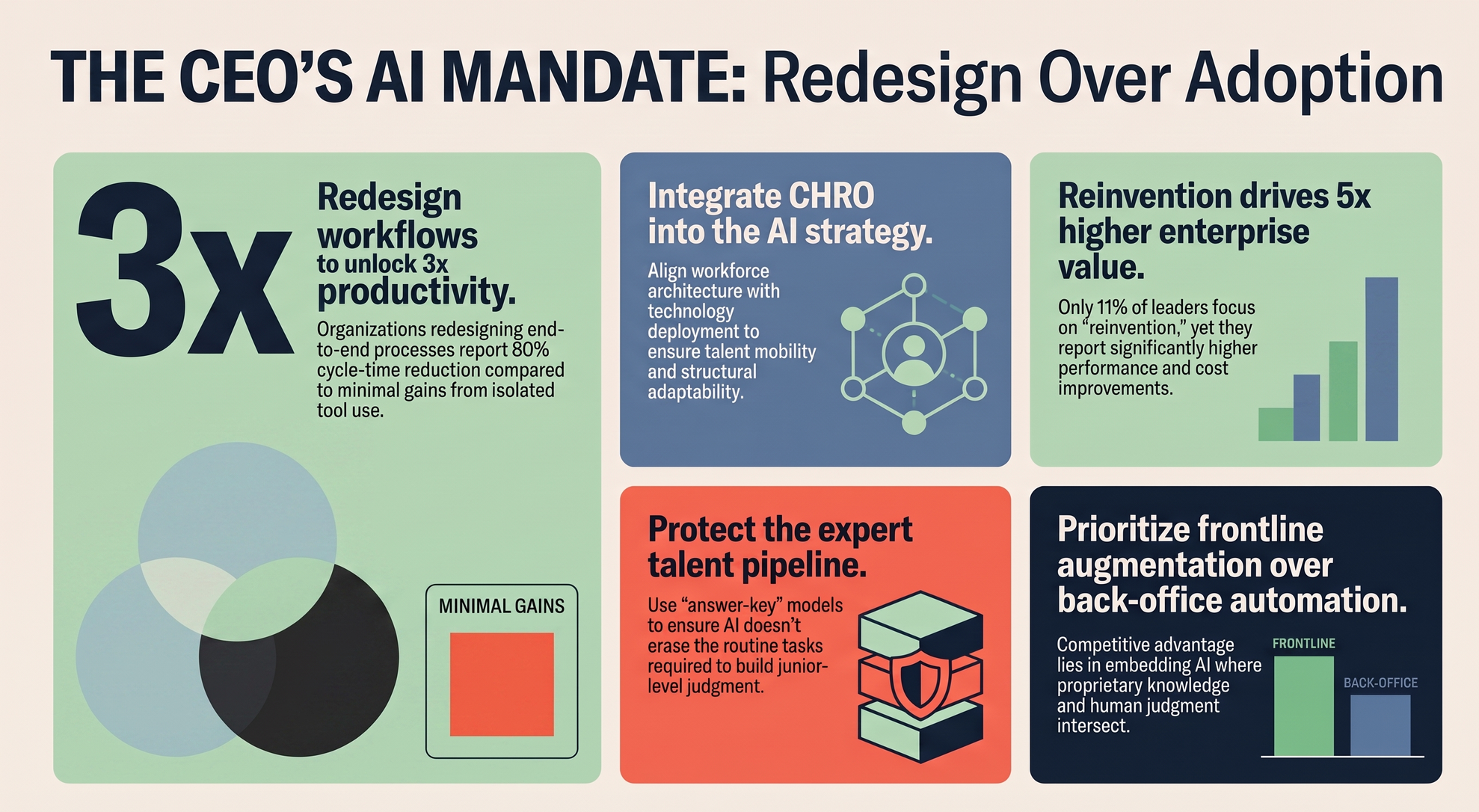
Table of Contents
- Technology Potential & Capabilities How human–AI operating models raise throughput and control when work is redesigned end to end.
- Human Resources & Skills Development Why training alone falls short — and how roles, learning, and expertise must be rebuilt.
- Business Model & Organisational Transformation Why the organisation, not the employee, is now the primary constraint on AI value.
- Investment & Return on AI Workforce Transformation How to separate gross automation potential from measurable net value.
- Industry Applications & Competitive Advantage Where augmenting high-value frontline work out-competes automating low-cost tasks.
- Cross-Article Strategic Synthesis Where the five firms agree, and the trade-offs leaders must navigate.
Technology Potential & AI Workforce Capabilities
Human–AI operating models increase capacity — but only when work is redesigned end to end.
Human–AI operating model — A human–AI operating model defines how employees, AI assistants, and autonomous agents divide work. It specifies which activities AI may execute, which decisions remain human, when exceptions must be escalated, and how performance is audited.
Strategic Core
AI is evolving from a tool used by employees into a source of operational capacity.
McKinsey & Company estimates that close to 60% of total work hours are theoretically automatable using current cognitive and physical AI capabilities. This is a technical potential, not a forecast of actual job displacement. Economics, regulation, organisational readiness, and implementation constraints will determine what is actually deployed.
The executive decision is therefore not whether to automate everything technically possible. It is where AI can improve an end-to-end business outcome while preserving accountability, judgment, and control.
Strategic Insights
BCG reports a wide performance gap between tool deployment and process redesign. Its early agentic engagements produced reported productivity gains of approximately three times, cycle-time reductions of 80%, and long-term cost reductions of at least 60%. Organisations applying AI without redesigning the operating system of work often achieved only 10% to 20% productivity improvement. These figures are consulting-reported client outcomes, not market-wide audited averages. They still illustrate an important pattern: value increases when agents manage connected tasks, handoffs, and exceptions rather than accelerate isolated employee activities.
- Separate technical automation potential from the economically and operationally viable opportunity.
- Select a small number of material workflows and redesign them from the desired outcome backward.
- Establish outcome-based monitoring for automation levels, cycle time, exceptions, quality, and value realisation.
- Define the conditions under which AI must escalate decisions to accountable employees.
Which of our workflows would produce a different outcome if it were designed around human and AI capabilities from the beginning?
Human Resources & Skills Development
Why training alone won't prepare an organisation — and how roles, learning, and expertise must be rebuilt.
Workforce architecture — The system connecting roles, capabilities, career paths, learning, mobility, performance measures, and workforce demand. In an AI-enabled company, it must also account for the capabilities supplied by agents.
Strategic Core
Skills training alone will not prepare an organisation for AI-enabled work.
PwC argues that technology and people strategies must be designed together. AI changes the substance of roles, not only the tools used within them. Leadership must determine which responsibilities are removed, which become more important, and which new accountabilities emerge. The CHRO should be involved from the outset alongside business and technology leaders to jointly shape AI workforce transformation. Bringing HR into the programme after technology decisions have been made leaves the organisation managing structural design problems as downstream adoption issues.
Strategic Insights
The talent pipeline creates a less visible risk. McKinsey & Company finds that AI can absorb routine entry-level work through which employees traditionally developed judgment. It proposes an 'answer-key' model: employees complete an analysis independently, compare it with AI output, and review the difference with a manager. The narrowing gap becomes a process-level measure of developing judgment. This model preserves challenge, coaching, and contextual learning while allowing AI to accelerate feedback. It also shifts management from supervising task mechanics toward coaching decisions and trade-offs.
- Make the CHRO a co-author of AI strategy before foundational technology, role, and workforce-design decisions are made.
- Redesign entry-level work to preserve independent reasoning, coaching, and exposure to expert judgment.
- Align incentives and career pathways with the responsibilities employees will perform after workflow redesign.
- Track skill development through observable work outputs rather than course completion alone.
What work currently develops our future experts, and how will that development occur after AI absorbs the routine tasks?
Business Model & Organisational Transformation
Why the organisation — not the employee — is now the primary constraint on enterprise AI value.
Organisational reinvention — Redesigning roles, workflows, decision rights, structures, and performance systems around what AI makes possible. It goes beyond improving the speed of an existing process.
Strategic Core
The organisation, not the employee, has become the primary constraint on enterprise AI value. McKinsey & Company defines three horizons of transformation: enablement, automation, and reinvention. Enablement gives employees access to AI tools. Automation improves existing cross-functional processes. Reinvention redesigns work and the operating model from the ground up. Only 11% of surveyed leaders placed their organisations in the reinvention horizon — and that group was the most likely to report meaningful improvements in performance, cost, employee experience, or customer outcomes.
Strategic Insights
The difference is measurable. In the enablement horizon, McKinsey & Company found that leaders were 5.3 times more likely to report enterprise value when workflows were redesigned rather than left unchanged: 32% compared with 6%. In the automation horizon, leadership teams with high AI fluency were 3.9 times more likely to report value than teams with low fluency. Also in the automation horizon, leaders receiving adequate support and training were 3.3 times more likely to report enterprise value than those who did not: 30% compared with 9%. These are survey associations rather than proof of causality, but they reinforce the need to align strategy, leadership capability, and organisational design.
- Diagnose whether the organisation is enabling employees, automating processes, or reinventing its operating model.
- Reconstruct decision rights and exception ownership as part of workflow design.
- Describe, role by role, how work will operate after transformation rather than communicating a generic future-of-work vision.
- Institutionalise rigorous performance transparency and regular process documentation to support reinvention and sustained scaling.
Are we using AI to accelerate the current organisation, or to design a more effective one?
Investment & Return on AI Workforce Transformation
How to separate gross automation potential from measurable net value.
Structural AI value — The measurable improvement created by changing how work is organised. It can include lower cost per case, shorter cycle time, increased throughput, reduced error, higher revenue capacity, and better customer outcomes.
Strategic Core
AI investment cases should evaluate organisational transformation as rigorously as technology investment, because sustainable AI value depends on both.
Bain & Company reports that close to 40% of companies measuring AI cost savings achieved less than 10%, despite targeting savings between 11% and 20%. Bain indicates that companies create more value when AI is combined with workflow redesign rather than layered onto existing processes. Leaders should establish clear workflow baselines and value measures to evaluate AI investments and support scaling decisions. That baseline should include employee hours, queue time, handoffs, straight-through-processing rates, exception volumes, rework, quality assurance, and cost per completed outcome.
Strategic Insights
An integrated human–AI workforce system can contribute to stronger financial performance. Accenture studied 1,320 executives and 4,560 employees across 20 industries and 12 countries. It identified 18% of organisations as 'Talent Reinventors.' These companies reported revenue growth 1.8 percentage points higher and profit growth 1.4 percentage points higher than peers. They were also roughly four times more likely to have a workforce that can pivot quickly across roles. The study shows association, not definitive causation. Even so, it supports a broader investment principle: talent visibility, mobility, learning, and human–AI team design should be treated as enterprise capabilities that contribute to value creation.
- Establish workflow baselines and validate the business case before scaling AI-led process and workforce redesign.
- Treat internal mobility, AI-informed capability data, and embedded learning as enterprise capabilities that enable AI value.
- Model the actual level of human review rather than assuming full autonomy in projected savings.
- Measure workforce adaptability and innovation-related capabilities alongside financial and operational outcomes.
Does our AI business case measure net transformation value, or only gross labour capacity?
Industry Applications & Competitive Advantage
Where augmenting high-value frontline work can out-compete automating low-cost tasks.
Frontline augmentation — Applying AI to roles that directly influence customers, revenue, service quality, production, or operational resilience. The goal is to improve human performance in moments where domain judgment and relationships matter.
Strategic Core
Back-office automation can lower cost, but it may offer limited differentiation when competitors can purchase similar tools. Bain & Company argues that a stronger competitive opportunity may lie in augmenting frontline work. Sales teams can spend less time searching for information. Frontline employees can use standardised workflows, proprietary data, and AI insights to deliver more consistent customer outcomes. Frontline experts can access proprietary data and AI-generated insights faster to improve decision quality. Industrial field-service and technical teams can use AI-supported insights to improve frontline decisions and performance. The operating principle is to use AI where proprietary knowledge, human judgment, and customer outcomes intersect — not simply where labour is easiest to remove.
Strategic Insights
Industry implementation must reflect sector-specific accountability. Financial institutions should combine AI-enabled workflows with defined governance, controls, accountability, and auditability. Industrial organisations must connect productivity objectives with safety, reliability, and physical controls. Customer-facing businesses should measure revenue, resolution performance, customer outcomes, and quality — not only time saved. Competitive advantage is likely to come from embedding AI in proprietary workflows and strengthening high-value roles before those practices become standard.
- Prioritise frontline workflows where better judgment can improve revenue, service, and customer outcomes.
- Define target outcomes and value measures before redesigning workflows and making technology choices.
- Include the CHRO and people-and-organisation expertise when designing high-impact AI use cases and foundational transformation decisions.
- Define accountable human orchestration and oversight for consequential AI decisions and safety-critical operations.
Where could augmenting our highest-value employees create more advantage than automating our lowest-cost activities?
Cross-Article Strategic Synthesis
Where the firms agree — and the trade-offs leaders must navigate.
Strategic Consensus Map
Five points of agreement across the firms:
- Workflow redesign is the main value mechanism. McKinsey, BCG, Bain, and PwC agree that individual adoption is insufficient; enterprise value requires redesigning workflows, roles, decisions, structures, and human–AI collaboration around the outcomes AI makes possible.
- Technology and workforce design must be governed together. PwC positions the CHRO as a co-author of AI strategy; Accenture adds quantitative evidence linking integrated talent and AI strategies with stronger reported performance.
- Leadership fluency matters. Senior leaders must understand enough about AI to make decisions on workflow design, investment, risk, authority, and structure. Delegating the agenda entirely to technology teams limits the company to implementation rather than reinvention.
- Human oversight remains part of the economics. Most deployed systems still require approvals, guardrails, or exception handling. Business cases should reflect the actual human workload; assumed autonomy should not be counted as realised savings.
- Trust is an operating requirement. Employees need clarity about how roles will change and how decisions will be made. Trust affects adoption, learning, knowledge sharing, and the willingness to redesign work.
Strategic Tensions
Where the firms diverge, and what that divergence means for executive decision-making:
- "Cost reduction" vs "Growth capacity." Bain emphasises structural economics and the gap between expected and realised savings; PwC cautions against directing every productivity gain toward workforce reduction. The choice is whether released capacity funds margin, growth, service, or resilience.
- "Automation" vs "Augmentation." BCG emphasises agent-driven execution of end-to-end tasks; Bain emphasises strengthening frontline employees. The right model depends on process variability, regulatory exposure, customer sensitivity, and the importance of human judgment.
- "Dynamic skills" vs "Durable expertise." Accenture favours dynamic talent mobility and AI-informed capability data; McKinsey warns that removing routine work can weaken apprenticeship. Organisations need both mobility and depth.
- "Central governance" vs "Local experimentation." Enterprise standards improve auditability, consistency, and risk control; local experimentation improves relevance and speed. Leaders need a federated model: central policies and assurance combined with business-owned workflow redesign.
Executive Reflection
If the technology is ready and the organisation is the constraint, the decisive question is no longer which AI to buy. It is whether the people redesigning your work hold the mandate to redesign the organisation around it.
Sources & References
Primary sources
- McKinsey & Company — "AI Value Will Depend on Organisational Reinvention, Not Just Employee Adoption · July 2026" https://www.mckinsey.com/business-functions/people-and-organizational-performance/our-insights
- BCG — "AI-First Enterprise Operations: Reinventing the Operating System of Work · 2026" https://www.bcg.com/publications/2026/reinventing-the-operating-system-of-work-with-ai
- Bain & Company — "How Companies Create Value with AI: Redesign, Not Tools · 2026" https://www.bain.com/insights/how-do-companies-create-value-with-ai/
- Accenture — "Talent Reinventors: Value in the Age of AI · 2026" https://www.accenture.com/us-en/insights/consulting/talent-reinventors-delivering-value-people-age-ai
- PwC — "The Uncomfortable Truth About AI: Your Technology Is Ready. Your Organization Isn't · 2026" https://www.pwc.com/us/en/services/ai/uncomfortable-truth-about-ai-workforce-transformation.html
Supplementary sources
- McKinsey & Company — "Superagency in the Workplace: Empowering People to Unlock AI's Full Potential · Jan 2025" https://www.mckinsey.com/capabilities/tech-and-ai/our-insights/superagency-in-the-workplace-empowering-people-to-unlock-ais-full-potential-at-work