
Why Is AI Governance Moving From Policy to Runtime Control?
AI agents can increasingly access enterprise data, invoke software and execute business actions autonomously. That is pushing AI governance beyond policies and review committees toward runtime controls covering identity, permissions, monitoring, human oversight and auditability.


Policy-led oversight has reached its limit. Runtime governance is what lets the enterprise safely delegate consequential work to AI.
AI governance is entering a more consequential phase. As AI systems move beyond generating recommendations and begin accessing data, invoking software, initiating workflows, and executing business actions, traditional policy-led oversight is becoming insufficient. The decision horizon is immediate: enterprises are already deploying agents into customer service, operations, finance, procurement, and regulated workflows, while boards remain accountable for actions they may not yet be able to trace or stop in real time.
Across BCG, Bain & Company, Forrester, Gartner, KPMG, PwC, EY, Deloitte, and McKinsey, the direction is increasingly consistent: governance must become embedded, continuous, and proportional to autonomy. The strategic opportunity is not to constrain AI. It is to institutionalize enough control that the enterprise can safely delegate more consequential work to it.
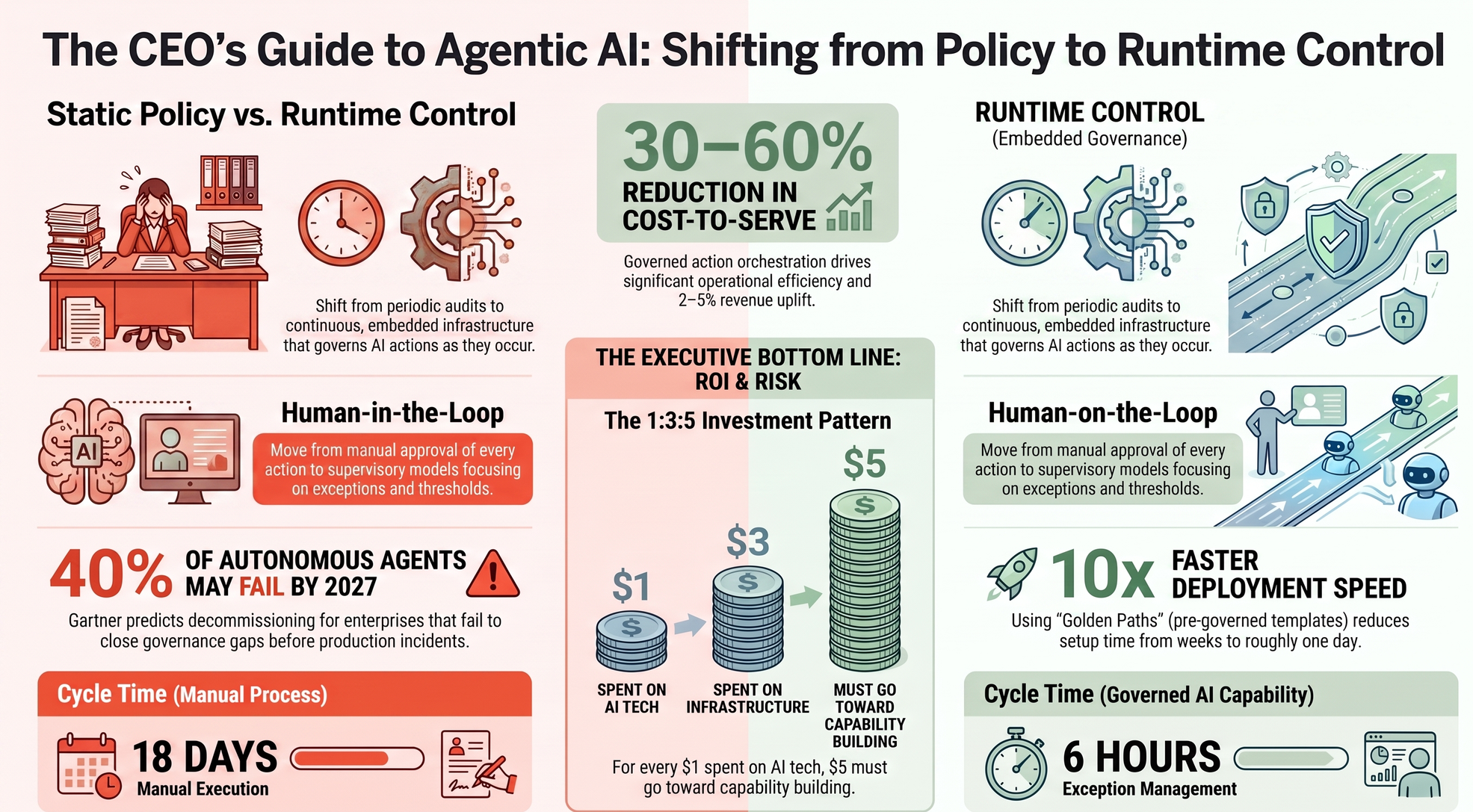
Table of Contents
- Technology Potential & Capabilities How runtime controls, identity, permissions, observability, and enterprise control planes are changing the technical foundation of AI governance.
- Human Resources & Skills Development How leadership roles, oversight models, and workforce capabilities must evolve as humans move from approving every action to supervising AI systems.
- Business Model Transformation How governed AI agents can compress workflows, reduce handoffs, and shift operating models toward orchestration and exception management.
- Investment & Return on Investment How stronger control architecture can support faster deployment, safer autonomy, and clearer process-level economics.
- Industry Applications How runtime AI governance is being applied across customer service, finance, regulated industries, and other consequential workflows.
- Cross-Article Strategic Synthesis Where nine advisory firms converge on runtime governance — and the three tensions that divide them.
Technology Potential & Capabilities
Runtime controls, identity, and observability are becoming the technical foundation of AI governance.
Runtime governance — Controls applied while an AI system is operating rather than only before deployment.
AI control plane — A centralized governance layer that can manage agent identity, permissions, policy enforcement, monitoring and intervention across different AI platforms.
Least agency — Limiting an AI agent not only to the minimum data it needs, but also to the minimum actions and autonomy required to complete its role.
Observability — The ability to reconstruct what an agent accessed, attempted, executed and changed.
Strategic Core
The technology shift is toward governing distributed ecosystems of autonomous AI agents rather than relying on fragmented platform- or policy-based controls.
BCG recommends an Enterprise AI Control Plane that sits across platforms and centralizes identity, registration, runtime policy enforcement and visibility. Bain & Company reaches a similar conclusion: policies and review boards cannot scale to hundreds of agents acting thousands of times a day. Controls must increasingly be encoded into the environment in which agents operate.
Forrester extends the concept further by arguing that enterprises need to secure an agent's intent and behavior, not simply authenticate its identity.
Strategic Insights
Governance architecture can also improve deployment velocity. BCG describes 'golden paths': pre-governed production templates where identity, registration, monitoring and policy controls are embedded from the start. The firm estimates that this approach can reduce governed setup from weeks to roughly a day — an improvement on the order of 10× in compliant deployment speed.
Bain & Company similarly recommends per-agent identities, minimum permissions, spend limits, prohibited actions, circuit breakers, rollback mechanisms and tamper-resistant audit trails.
The implication is strategic: governance architecture can become a productivity layer rather than a compliance checkpoint.
- Institutionalize a common control layer before agent adoption fragments across business units and vendors.
- Define agent identity, permissions, behavioral limits and intervention mechanisms before expanding autonomy.
- Extend cybersecurity beyond infrastructure protection toward securing agent intent, enforcing least agency and monitoring emergent behavior.
Human Resources & Skills Development
Human oversight is shifting from approving every action to supervising exceptions, thresholds, and consequential decisions.
Human-in-the-loop — A person approves or completes important steps before the AI can proceed.
Human-on-the-loop — AI executes within defined boundaries while a person supervises performance and intervenes when thresholds are crossed.
Agent manager — A role in which employees supervise, evaluate and orchestrate AI systems rather than manually execute every underlying task.
Strategic Core
As agentic autonomy increases, the role of human oversight shifts from individual approval toward supervision and targeted intervention. Human approval can provide control, but as agentic systems scale, organizations will increasingly need supervisory models supported by telemetry and targeted intervention.
Deloitte describes an emerging autonomy spectrum from human-in-the-loop to human-on-the-loop and, for selected processes, human-out-of-the-loop with continuous monitoring.
McKinsey adds the organizational requirement: agentic transformation requires redesigning how judgment is distributed between people and machines. Governance therefore becomes both a technology and workforce operating-model decision.
Strategic Insights
The investment profile may be more organizational than technological. McKinsey describes a 1:3:5 pattern in successful transformations: for each unit invested in agentic technology, approximately three go toward process redesign and five toward capability building and adoption. The firm notes that many organizations invert this allocation by concentrating executive attention on technology.
Deloitte expects more advanced organizations to move toward human-on-the-loop supervision, supported by telemetry, outcome tracing and orchestration dashboards.
- Treat process redesign and workforce capability as core AI investments rather than implementation details.
- Define which workflows require human approval and which can move toward supervisory oversight based on complexity, risk and outcome criticality.
- Preserve named human accountability even when individual agent actions no longer receive manual approval.
Business Model Transformation
Governed agents compress workflows and shift operating models toward orchestration and exception management.
Agent sprawl — The uncontrolled proliferation of independent agents across functions, vendors and technology platforms.
Orchestration — Coordinating multiple agents, tools and systems around an end-to-end business outcome.
Golden path — A standardized, pre-governed route for deploying AI systems using approved controls and architecture.
Strategic Core
The strategic shift is from automating isolated tasks toward governing AI across complete workflows.
KPMG argues that agent proliferation creates fragmentation when teams independently build isolated agents for specific use cases. Its alternative is a smaller number of governed Superagents that orchestrate and reuse capabilities across end-to-end workflows.
BCG takes a complementary view: the control layer should sit above individual development platforms, so business units retain flexibility while the enterprise institutionalizes common identity, policy and observability.
Strategic Insights
Adoption is already creating architecture pressure. KPMG reports that more than half of organizations in its Q1 2026 AI Pulse were already running AI agents in production.
Its vendor-onboarding illustration shows how a compliance chain that could take 18 days may be compressed to roughly six hours when work is executed in parallel by governed AI capabilities, leaving compliance professionals to manage exceptions.
This is not simply task automation. It changes the operating model from sequential handoffs toward end-to-end orchestration, parallel execution and exception management.
- Measure AI progress through workflow outcomes, cycle time and exception handling — not the number of agents deployed.
- Standardize governance while preserving flexibility in the underlying technology used by business teams.
- Build for interoperability, coordination, observability and traceability as multiagent systems scale.
Investment & Return on Investment
Stronger control architecture supports faster deployment, safer autonomy, and clearer process-level economics.
Cost-to-serve — The total operating cost required to deliver a service or customer interaction.
Risk-adjusted ROI — Financial value assessed alongside operational, compliance and downside risk.
Governance dividend — The potential economic benefit created when stronger controls allow an organization to safely automate a larger portion of a workflow.
Strategic Core
The business case for runtime governance strengthens when controls enable greater automation and faster deployment while keeping operational risk within defined boundaries.
PwC documents enterprise architectures where governed action orchestration supports measurable service and revenue outcomes. BCG makes the complementary case that pre-governed deployment paths can reduce implementation friction.
Gartner, however, warns that controls must remain proportional: excessive restrictions can slow simple agents, while inadequate controls leave highly autonomous agents exposed.
Strategic Insights
Across applicable deployments, PwC reports up to 30–60%+ reductions in cost-to-serve, 2–5% revenue uplift, and 10–15 basis points of improvement in CSAT/NPS from its agentic customer-engagement architecture. These results are deployment-specific rather than universal benchmarks, but they illustrate the potential economic value of greater AI-enabled workflow automation.
The countervailing risk is material: Gartner predicts 40% of enterprises will demote or decommission autonomous AI agents by 2027 because governance gaps become visible only after production incidents.
- Connect agentic workflow automation to process-level economics such as cost-to-serve, revenue uplift and service quality.
- Match governance intensity to an agent's autonomy and system access rather than applying one enterprise-wide control level.
- Treat reusable governance infrastructure as an investment in faster compliant deployment rather than pure overhead.
Industry Applications
Where runtime governance is landing first: customer engagement, finance, procurement, and regulated workflows.
Nonhuman identity — A digital identity assigned to a machine, service or AI agent rather than an employee.
Exception management — An operating model where automation handles standard cases and humans focus on unusual, ambiguous or high-risk cases.
Runtime guardrail — A technical limit that blocks, redirects, escalates or terminates an AI action during execution.
Strategic Core
Runtime governance becomes increasingly important as AI moves into workflows affecting customers, regulated data, financial decisions or critical operations.
PwC shows its relevance in customer engagement, where AI can combine real-time interaction with governed action across enterprise systems. KPMG illustrates the model in vendor onboarding, legal operations and M&A diligence.
EY broadens the risk frame: organizations increasingly need real-time visibility into machine identities, permissions and execution paths across interconnected technology estates.
Strategic Insights
Many organizations already have material visibility and control gaps that agentic AI can further amplify. EY surveyed 840 C-suite and cybersecurity leaders across 17 sectors and 128 countries and found that, on average, 36% of organizational assets sat in a 'vulnerability zone' with below-average visibility and cybersecurity coverage.
The implication for AI governance is significant: agents can interact with systems that enterprises may not fully understand or monitor today. EY therefore recommends continuous discovery, visibility into nonhuman identities, least-privilege access and runtime controls for SaaS and third-party integrations.
- Extend real-time asset and identity visibility to AI agents as they gain access across enterprise systems and sensitive workflows.
- Start with one workflow, deploy a governed Superagent and prove measurable business outcomes and cycle-time improvement before scaling.
- Separate engagement orchestration from action orchestration to strengthen governance and interoperability as AI executes across enterprise workflows.
Cross-Article Strategic Synthesis
Where nine advisory firms converge on controlled autonomy — and where they sharply diverge.
Strategic Consensus Map
Five points of convergence stand out across the research:
- Policy alone will not scale. Bain & Company argues that controls must live in the platform itself; BCG similarly places runtime policy enforcement inside an enterprise-wide control plane.
- Every consequential agent needs an identity and an owner. Bain & Company and KPMG converge on identity, permissioning and traceability as foundational controls.
- Observability becomes a governance function. It is no longer enough to know that an AI service is online — leaders need visibility into what an agent attempted, what systems it touched and what outcome it produced. Bain & Company and Deloitte both emphasize continuous telemetry and outcome tracing.
- Human oversight must evolve. Deloitte anticipates movement toward human-on-the-loop models; McKinsey emphasizes redesigning how human and machine judgment interact.
- Governance should enable autonomy rather than eliminate it. BCG and Bain & Company explicitly treat governance as a mechanism for scaling AI; Gartner adds the qualifier that controls should be proportional to autonomy and access.
Strategic Tensions
Where the firms diverge — and what that divergence means for executive decision-making:
- "Control" vs "Speed." BCG argues that standardized governance can increase deployment speed by making the compliant path the easy path; Gartner warns that indiscriminate governance instead creates over-restriction and shadow development. The difference is not whether controls exist — it is whether they are risk-differentiated and embedded in the workflow.
- "Human-in-the-loop" vs "Human-on-the-loop." The intuitive response to autonomous AI risk is to require human approval, but Deloitte shows why that assumption breaks at scale: high-volume autonomous systems require telemetry and exception-based supervision, and Bain & Company notes that no supervisor can realistically review thousands of actions a day.
- "More agents" vs "Fewer orchestrated systems." KPMG takes a strong position against agent proliferation, favouring a small number of governed orchestration systems; BCG is more architecture-neutral, assuming proliferation but proposing a shared control layer above the fragmented ecosystem. Both address the same problem but imply different technology strategies.
Executive Reflection
If an AI agent exceeded its intended mandate today, would your systems detect the deviation before the business impact occurred — and how much more consequential work would you delegate to AI if the answer were yes?
Sources & References
Primary sources
- BCG — "Enterprise AI Control Plane: The CIO's Guide to Governing and Accelerating AI Agents · Aug 2026" https://www.bcg.com/publications/2026/how-cios-govern-ai-agents-at-scale
- Bain & Company — "Agentic AI Governance, Risk, and Controls for Business Leaders · July 2026" https://www.bain.com/insights/agentic-ai-governance-risk-and-controls-for-business-leaders/
- Forrester — "The AEGIS Framework: Enterprise Guardrails for Securing Agentic AI · 2025/2026" https://www.forrester.com/technology/aegis-framework/
- Deloitte — "The Measured Leap: AI Agent Observability" https://www.deloitte.com/us/en/services/consulting/articles/ai-agent-observability-human-in-the-loop.html
- McKinsey & Company — "Agentic AI Change Management: Closing the Adoption Gap · Aug 2026" https://www.mckinsey.com/capabilities/people-and-organizational-performance/our-insights/how-to-close-the-agentic-adoption-gap
- KPMG — "From Agent Sprawl to Enterprise Outcomes · June 2026" https://kpmg.com/us/en/articles/2026/from-agent-sprawl-to-enterprise-outcomes.html
- PwC — "Agentic AI Architecture for Customer Engagement · May 2026" https://www.pwc.com/us/en/tech-effect/ai-analytics/agentic-ai-customer-engagement-architecture.html
- Gartner — "Applying Uniform Governance Across AI Agents Will Lead to Enterprise AI Agent Failure · May 2026" https://www.gartner.com/en/newsroom/press-releases/2026-05-26-gartner-says-applying-uniform-governance-across-ai-agents-will-lead-to-enterprise-ai-agent-failure
- EY — "Cybersecurity Resilience for Frontier AI Vulnerabilities · June 2026" https://www.ey.com/en_gl/insights/consulting/how-can-you-redefine-resilience-for-the-next-frontier-of-vulnerabilities
Supplementary sources
- Bain & Company — "Governance, Trust, and the Data Foundation · Apr 2026" https://www.bain.com/insights/governance-trust-and-the-data-foundation/
- KPMG — "AI Quarterly Pulse Survey: Q1 2026 · May 2026" https://kpmg.com/us/en/media/news/q1-ai-pulse2026.html