
Why are AI agents becoming a board-level operating risk and a near-term advantage at the same time?
AI agents are crossing a critical threshold: from generating recommendations to executing actions inside enterprise workflows.

EXECUTIVE SUMMARY
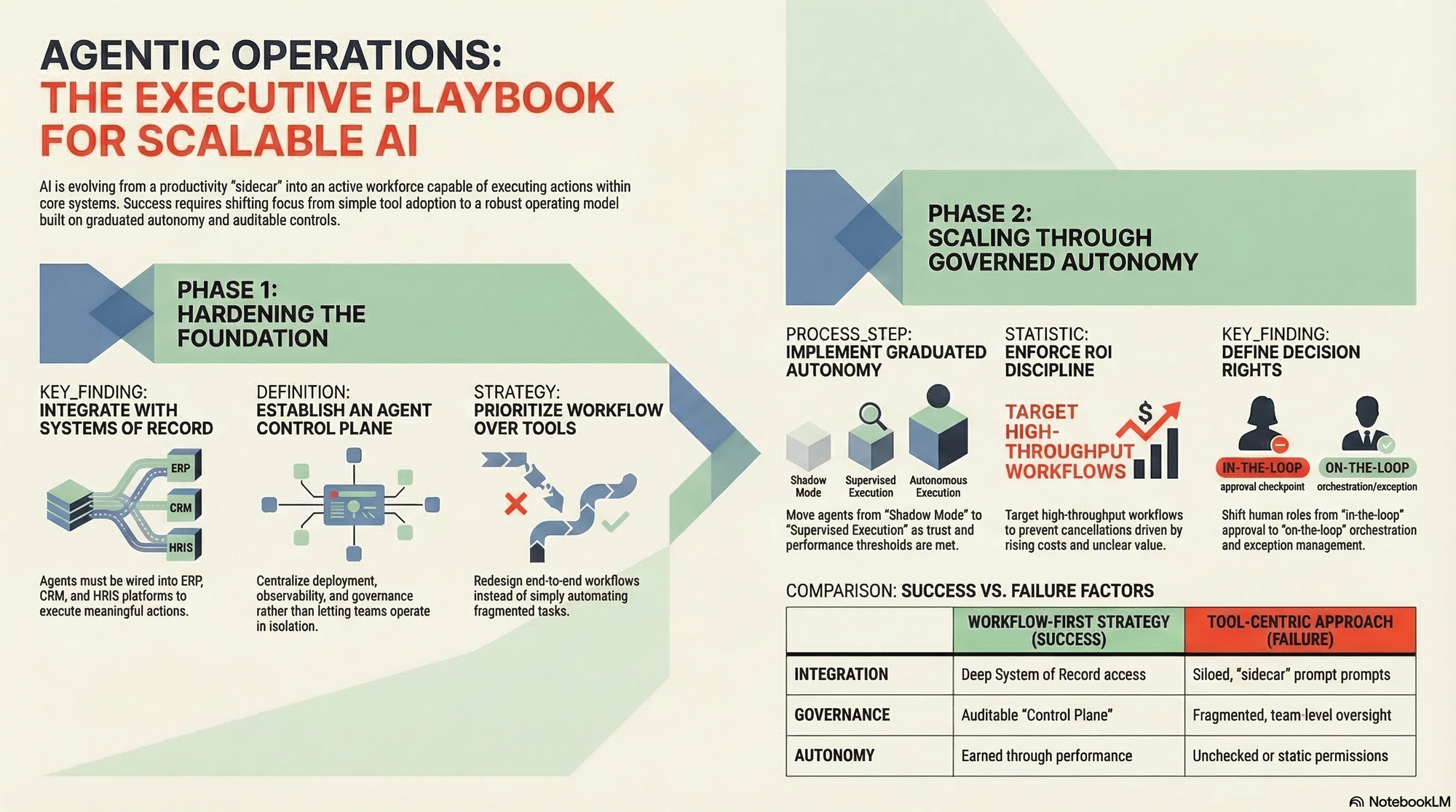
AI agents are crossing a critical threshold: from generating recommendations to executing actions inside enterprise workflows. That transition moves AI from experimentation into operating model territory. The window for leadership decisions is narrowing. As adoption accelerates, organizations must define governance boundaries, workflow ownership, and measurable ROI before agent autonomy expands informally across teams. Across the major consulting firms—McKinsey, Bain, Accenture, PwC, Deloitte, BCG, Gartner, and Forrester—the message is consistent: agentic AI succeeds when integrated into systems of record, governed through enterprise controls, and measured through operational outcomes. This briefing outlines the emerging playbook: workflow-first transformation, graduated autonomy, and disciplined investment in a small set of high-impact processes.
Key Findings at a Glance
- Reading time: ~8 minutes
- Sources: 10 firms (consulting + analyst) — McKinsey & Company · Accenture · Forrester · Deloitte · Boston Consulting Group · PwC · Bain & Company · Gartner · KPMG · EY
- What's changed: The conversation is moving from "copilots for productivity" to agents that execute work inside core workflows—which forces executives to make operating model decisions (decision rights, controls, audit trails) rather than "tool adoption" choices.
- What wins: Workflow-first, control-first scale. Integrate agents into systems of record, stage autonomy, instrument value, and make governance auditable from day one.
- What fails: Programs without clear value metrics and risk controls; analysts forecast material cancellation rates when costs rise and value stays unclear.
Drivers
- Decision timeline pressure: Autonomy boundaries and workflow selection cannot be delegated indefinitely once pilots become production candidates.
- Competitive window closing: Early movers will institutionalize operating routines and data advantages that are harder to catch than a model subscription.
- Regulatory / audit reality: Agents acting in core systems expand accountability; audit trails and governance frameworks become gating criteria.
- Technology maturity inflection: The constraint is no longer "model capability," but integration, control, and operating model readiness.
- Market adoption acceleration: Analyst forecasts point to rapid adoption in customer interaction use cases—and high cancellation rates where discipline is missing.
Table of Contents
- Technology Potential & Capabilities — How to scale agents by integrating them into systems of record and funding an enterprise control plane.
- Human Resources & Skills Development — How to manage a "silicon workforce" with decision rights, escalation rules, and accountable owners.
- Business Model Transformation — How graduated autonomy turns trust and governance into a repeatable scaling mechanism.
- Investment & Return on Investment — How to fund fewer, bigger workflow bets and prove ROI with operational metrics executives can defend.
- Industry Applications — Where agents create measurable advantage first—and where governance must be strictest to protect margin and trust.
- Cross-Article Strategic Synthesis
Technology Potential & Capabilities
Key Terms
- Agentic operations
- AI systems that can take actions inside business workflows (not just generate content).
- Systems of record
- Core platforms where "truth" lives—ERP, CRM, HRIS, ITSM—where actions must be governed.
- Agent control plane
- The tooling layer that helps you build, deploy, observe, and govern agents at scale.
Strategic Core
Agentic value does not scale on prompts alone. It scales when agents are wired into systems of record with clear permissions, logging, and exception handling. The operating logic is simple: if the agent cannot reliably read, decide, and act in the same systems humans use, it remains a sidecar.
Leaders should treat integration capability as strategic infrastructure. This is where most programs slow down—legacy complexity, fragile interfaces, and unclear workflow ownership. Executives need to decide which workflows become "agent-ready" first, and which core systems must be hardened to support controlled autonomy.
Strategic Insights
The leading constraint is not model capability. It is enterprise readiness—workflow clarity, system integration, and "control plane" maturity.
- McKinsey & Company explicitly frames an "AI vs ERP" resource divide where core enterprise capabilities are underfunded even as AI budgets rise.
- Accenture adds that scaling requires platform evolution—agents working across multiple systems, with humans shifting to orchestration roles. It reports most organizations rely primarily on platform-native AI, while a meaningful minority are building cross-platform agents—signaling a hybrid future.
- Forrester frames this as an emerging market: building agents, embedding them into workflows, and governing them at scale are distinct capability planes—and AI platforms increasingly bundle essentials like tool integration and evaluation pipelines.
Executive Takeaways
- Prioritize "workflow + system-of-record integration" before expanding agent pilots across the enterprise.
- Institutionalize a hybrid platform strategy—agents will operate inside and across platforms; design for both.
- Establish an agent control plane (evaluation, deployment, observability) as a shared enterprise capability, rather than letting each team govern agents in isolation.
Human Resources & Skills Development
Key Terms
- Silicon-based workforce
- Agents treated as operational capacity that must be managed, monitored, and governed.
- Decision rights
- Who (human vs agent) can approve, execute, or override actions in a workflow.
- Human-in-the-loop / on-the-loop
- People approve actions (in-the-loop) or supervise exceptions (on-the-loop).
Strategic Core
Agentic operations create a new management problem: you are not just deploying software; you are deploying a workforce-like capability that acts. That shifts leadership responsibilities from "adoption" to "operational control."
Executives should define workflow-level decision rights, set clear performance and risk thresholds (speed vs accuracy), and establish a repeatable operating model to monitor, review, and improve agent behavior over time.
The skill gap is not coding. It is workflow ownership, risk design, and operational governance. Leaders must assign accountable owners for agent-enabled processes and ensure that teams can detect failure modes early—before autonomy expands.
Strategic Insights
Deloitte quantifies a clear pilot-to-production gap and warns that organizations often stall when they automate existing processes instead of redesigning workflows for agentic operations.
BCG highlights adoption momentum and frames management tensions: supervision vs autonomy, retrofitting vs reimagining processes. It recommends redesigning workflows and decision rights, not just deploying tools.
Taken together, the implication is governance-by-design: establish clear supervision and decision-rights by workflow, with enterprise guardrails and oversight mechanisms that evolve as autonomy increases.
Executive Takeaways
- Define clear governance and oversight for each agent-enabled workflow—who supervises, what guardrails apply, and how performance and risk are monitored as autonomy increases.
- Redesign decision rights by workflow and evolve human oversight from in-the-loop to on-the-loop as autonomy and performance prove reliable—backed by system-level guardrails and intervention mechanisms.
Business Model Transformation
Key Terms
- Graduated autonomy
- Agents earn increasing freedom as performance and controls prove reliable.
- End-to-end workflow
- A full business outcome stream (not a single task), e.g., order-to-cash, claims-to-resolution.
- Trust protocol
- Governance approach that ties autonomy to measurable performance thresholds.
Strategic Core
Agentic operations reshape how the company competes because they reshape how the company executes. The most durable gains come from redesigning end-to-end workflows and allowing agents to execute within explicit guardrails—not sprinkling AI across tasks.
The transformation is business-model adjacent: redesigning end-to-end workflows can materially improve cost, productivity, and service levels—shifting the economics and performance of core outcome streams.
Executives should adopt a graduated autonomy path: start in shadow mode, then supervised execution, then guided autonomy as controls mature. This creates a controlled path to scale—one that aligns operational trust with board risk appetite.
Strategic Insights
BCG provides a practical autonomy ladder with explicit human oversight modes and "trust as the barrier to scale."
PwC reinforces the operating-model shift: single agents don't move enterprise outcomes; orchestrated workflows do—supported by oversight, role-based access, and execution history.
Net: treat this as a workflow transformation strategy—not a feature rollout. Focus on a few priority end-to-end workflows and standardize the operating pattern (oversight, access controls, traceability) before expanding.
Executive Takeaways
- Adopt graduated autonomy and promote agents only when measurable trust and risk thresholds are met (e.g., accuracy/confidence and governance controls), with fallback to lower-autonomy modes when thresholds aren't sustained.
- Orchestrate agents into governed workflows with RBAC and execution history before scaling across functions.
Investment & Return on Investment
Key Terms
- ROI discipline
- Measuring value through operational metrics (cycle time, exceptions, cost per case) and stopping low-value pilots.
- EBITDA uplift
- A proxy for enterprise-level operational gains from scaled AI adoption.
- Cancellation risk
- Programs fail due to cost, unclear value, or inadequate risk controls—not because the models cannot work.
Strategic Core
The investment decision is shifting from "AI experimentation" to "operational modernization." ROI comes when agents improve measurable workflow outcomes—speed, cost, quality, and scale—in core processes, and those gains compound as adoption deepens across the workflow.
Treat this as a focused investment portfolio: concentrate resources on a small number of high-impact workflow transformations, and be disciplined about stopping initiatives that don't show measurable value.
Where ROI is unclear, it's often because the workflow is not redesigned, the integration is incomplete, or the risk controls are insufficient to allow meaningful autonomy.
Strategic Insights
Bain & Company reports that leaders have moved "from pilots to profits" and ties meaningful gains to scaling AI across core workflows—then positions agentic AI as the next compounding wave, provided agents can operate across silos.
Gartner provides the counterweight: many agentic AI projects are canceled due to escalating costs, unclear business value, or inadequate risk controls—highlighting execution and governance gaps rather than model limitations.
Taken together: ROI depends primarily on the operating model—workflow scaling, governance, controls, and measurable value—not on model choice alone.
Executive Takeaways
- Focus investment on scaling AI across a small set of core workflows, and track outcome metrics to sustain and compound gains as adoption deepens.
- Reduce cancellation risk by prioritizing use cases with clear business value and adequate risk controls, and avoid scaling agentic deployments where costs and controls are not yet understood.
Industry Applications
Key Terms
- One-to-one interactions
- Personalized customer engagement at scale across marketing, sales, and service.
- Centralized governance dashboard
- A control point for permissions, session tracking, execution history, and human oversight.
- Transparency requirements
- Clear explanations of when and how AI decisions are made—especially where customer outcomes are affected.
Strategic Core
Industry value tends to appear first in repeatable, high-frequency operational workflows—especially customer service, onboarding, procurement and targeted finance processes—where agents can be orchestrated safely at scale.
But the "industry story" is still fundamentally an operating model story: orchestrate agents into workflows, ensure role-based access, capture execution history, and keep humans responsible for exceptions.
In customer-facing settings, the governance bar rises because brand trust is on the line. Executives should set explicit decision boundaries and escalation rules for customer-facing actions, backed by role-based access controls and auditable execution history; then track business outcomes and governance indicators as core metrics.
Strategic Insights
PwC details the operational mechanics: session tracking, execution history, and human-in-the-loop feedback managed through a centralized governance dashboard—plus role-based access control to keep agent authority bounded.
Gartner forecasts widespread brand adoption for one-to-one interactions, while emphasizing governance, transparency, and organizational adaptation as prerequisites.
This implies an executive choice: prioritize the customer journeys for agentic use, and define governance guardrails (permissions, oversight, traceability) that preserve customer trust before expanding autonomy.
Executive Takeaways
- Gate customer-facing autonomy with RBAC (role-based access control), centralized oversight, and traceability (session tracking and execution history) so actions can be reviewed and governed.
- Make transparency and strong data governance explicit prerequisites for scaling customer interaction agents.
Cross-Article Strategic Synthesis
Strategic Consensus Map
Where leading firms align, tightly:
- Workflow-first beats tool-first. Redesign end-to-end workflows; don't automate fragments.
- Governance is a product requirement. RBAC, logging, evaluation, and auditability are not "phase two." They determine whether autonomy is allowed at all.
- Portfolio discipline matters. Projects fail when costs rise and value is unclear; measurement must be embedded from day one.
Strategic Tensions Analysis
Tension 1 — "ERP backbone-first" vs "Platform ecosystem-first"
McKinsey & Company emphasizes systems of record as the gating factor. Accenture emphasizes hybrid platform strategy and agent layers across systems.
Synthesis: these are not mutually exclusive; "backbone reliability" and "ecosystem interoperability" are complementary. The practical constraint is sequencing—start where integration is easiest, then expand.
Tension 2 — "Move fast" vs "Govern hard"
Gartner is explicit about cancellation drivers: cost, unclear value, and inadequate risk controls.
Reconciliation: BCG offers the mechanism—graduated autonomy tied to performance thresholds—making speed and governance complementary rather than opposed.
Executive Reflection
If an agent delivers a measurable business outcome but bypasses an established control—who in your organization owns the decision to allow it again? The answer to that question reveals whether your AI operating model is ready to scale.
Sources & References
Primary sources
-
McKinsey & Company "The agentic organization: Contours of the next paradigm for the AI era"
https://www.mckinsey.com/capabilities/people-and-organizational-performance/our-insights/the-agentic-organization-contours-of-the-next-paradigm-for-the-ai-era -
Bain & Company "State of the Art of Agentic AI Transformation"
https://www.bain.com/insights/state-of-the-art-of-agentic-ai-transformation-technology-report-2025/ -
Accenture "Six Key Insights for C-Suite Executives to Maximize Return on Agentic AI"
https://www.accenture.com/content/dam/accenture/final/accenture-com/document-4/Accenture-Six-Key-Insights-for-C-suite-Executives-to-Maximize-Return-on-Agentic-AI.pdf -
Deloitte "Health Care Leans into Agentic AI"
https://www.deloitte.com/us/en/insights/industry/health-care/agentic-ai-health-care-operating-model-change.html -
PwC "Agentic AI Workforce Redesign"
https://www.pwc.com/us/en/tech-effect/ai-analytics/agentic-ai-workforce-redesign.html
Secondary sources
-
McKinsey & Company "Deploying agentic AI with safety and security: A playbook for technology leaders"
https://www.mckinsey.com/capabilities/risk-and-resilience/our-insights/deploying-agentic-ai-with-safety-and-security-a-playbook-for-technology-leaders -
Bain & Company "Building the foundation for agentic AI"
https://www.bain.com/insights/building-the-foundation-for-agentic-ai-technology-report-2025/ -
Accenture "Agentic AI and the Future of Work in Financial Services"
https://bankingblog.accenture.com/agentic-ai-future-of-work -
Forrester "Announcing Our Evaluation of the Agent Control Plane Market"
https://www.forrester.com/blogs/announcing-our-evaluation-of-the-agent-control-plane-market/ -
Gartner "Gartner Predicts Over 40% of Agentic AI Projects Will Be Canceled by End of 2027"
https://www.gartner.com/en/newsroom/press-releases/2025-06-25-gartner-predicts-over-40-percent-of-agentic-ai-projects-will-be-canceled-by-end-of-2027 -
KPMG "The Agentic AI Advantage: Finance Agents That Move the Numbers"
https://kpmg.com/gh/en/home/insights/2026/020/the-agentic-ai-advantage-finance-agents-that-moves-the-numbers.html
COPYRIGHT & FAIR USE / FAIR DEALING NOTICE
This publication presents original synthesis and commentary based on publicly available research. References to third-party materials are used solely for purposes of analysis, commentary, and reporting, in accordance with Canadian fair dealing, U.S. fair use, and European right of quotation. All trademarks and publications are the property of their respective owners. This newsletter does not reproduce proprietary text, graphics, or datasets.
EDITORIAL RESPONSIBILITY DISCLAIMER
This newsletter provides interpretive analysis and is not a replacement for the original studies issued by referenced organizations. Readers seeking the full methodology, datasets, or detailed results should consult the original publications.