
Why Is AI Inference Becoming the Next Enterprise Cost-Control Agenda?
AI inference costs are becoming a C-suite issue. Learn how leaders can control AI token spend, optimize model usage and connect AI consumption to measurable business value.


AI inference is moving from an invisible technology expense to a managed economic input.
AI economics is entering the executive agenda faster than most corporate budgeting models are adapting. Falling model prices are encouraging more usage, longer reasoning and increasingly autonomous workflows—causing total inference demand to expand even as intelligence becomes cheaper per unit. The decision window is narrowing as enterprises move agents and generative AI from pilots into core processes, locking in architecture, vendor and operating-model choices that can be expensive to reverse. Across Accenture, Gartner, BCG, McKinsey & Company and other leading firms, the direction is increasingly clear: organizations need to institutionalize AI cost visibility, orchestrate model selection, assign economic ownership and measure value at workflow level. The competitive advantage will not come from consuming the most AI. It will come from knowing where premium intelligence improves economics—and where it quietly erodes them.
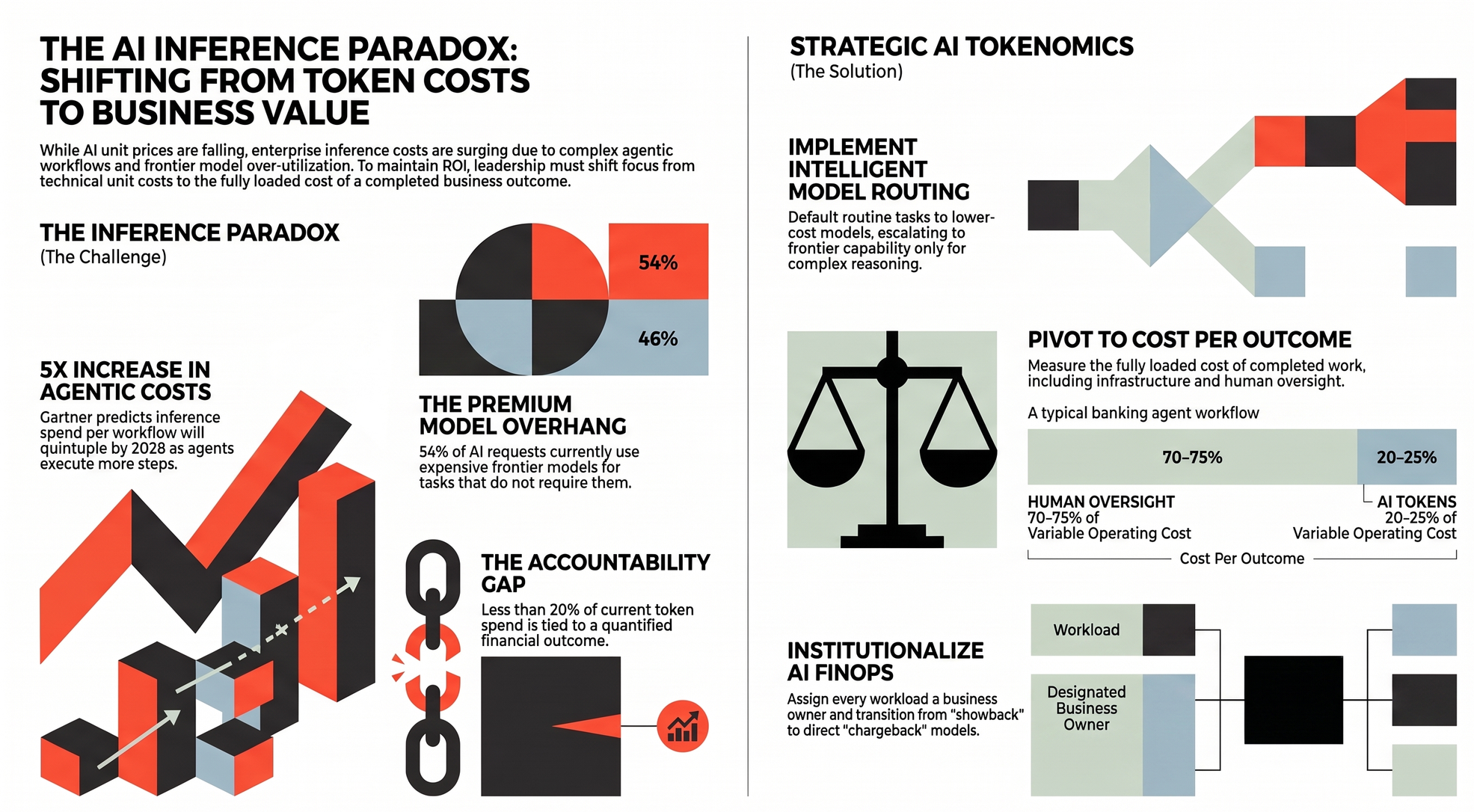
Table of Contents
- Technology Potential & Capabilities — The Multimodel Enterprise Why model routing is becoming a financial-control mechanism, and where frontier, specialized and open-weight AI fit into the enterprise portfolio.
- Human Resources & Skills Development — From AI Literacy to AI Economic Literacy How employee behavior, model choices and decentralized AI use are creating a new requirement for consumption accountability.
- Business Model Transformation — When Technology Spend Becomes Variable Economics Why AI is challenging traditional software budgeting, procurement and pricing models—and what CFOs need to operationalize differently.
- Investment & ROI — From Cost per Token to Cost per Outcome How leaders can evaluate the fully loaded economics of AI workflows and connect inference spending to productivity, margin and P&L impact.
- Industry Applications — Different Sectors, Different AI Economics How regulation, human oversight, sovereignty, latency and operating risk change the economics of AI across financial services, technology, consumer businesses and other sectors.
- Cross-Article Strategic Synthesis Consensus map and strategic tensions across the nine firms.
The Decision in Front of Executives
AI inference is moving from an invisible technology expense to a managed economic input.
That requires a different leadership question.
How much AI are we using?
Do we know which units of intelligence create enough enterprise value to justify what we are paying for them?
AI Tokenomics: Why Inference Economics Is Becoming a C-Suite Discipline
That apparent contradiction is becoming one of the most important economic questions in enterprise AI.
Gartner forecasts that inference cost per agentic workflow will increase more than fivefold through 2028, even as model prices continue to improve. Accenture finds that companies expect token consumption to grow 78% over the next 24 months, yet less than 20% of token spend can currently be connected to a quantified financial outcome.
The problem is not simply the price of a token. It is how many tokens, models, agents, tools and human review steps an enterprise workflow consumes before producing a trusted outcome.
AI economics needs to move from cost per token toward cost per completed business outcome.
Technology Potential & Capabilities
Build an Intelligence Portfolio, Not a Single-Model Strategy
AI inference — The process of a trained AI model producing an output from new input.
Model routing — Sending each task to the model that can meet its quality, latency, risk and cost requirements.
Frontier model — A highly capable general-purpose model, typically carrying a higher inference cost.
Fine-tuned model — A model adapted for a narrower task or domain using proprietary or specialist data.
Strategic Core
The technology decision is shifting from choosing the “best AI model” to orchestrating the right level of intelligence for each task. Gartner argues that more capable agentic systems can increase total inference expenditure because sophisticated, multistep workflows require substantially more inference than simple interactions. EY reaches a similar conclusion at workflow level: frontier models should be used selectively for hard-reasoning steps, while lower-cost models can handle routine tasks where less capability is sufficient. Forrester adds a structural alternative: smaller fine-tuned models, often built from open-weight models, are becoming economically practical for more specialized workloads.
Strategic Insights
The economic rationale for multimodel architectures is becoming measurable. Accenture reports that 54% of AI requests are routed to models more capable and expensive than the task requires, while its analysis of more than 9,000 tasks found that approximately 90% did not require frontier-model capability. EY identifies additional consumption drivers including expanding context, repeated retrieval, tool calls, retries and agent loops. Its recommendation is to measure consumption by workflow and task before attempting platform-level optimization.
- Institutionalize model routing so routine tasks default to capable lower-cost models and escalate to frontier capability only for complex reasoning, multi-source synthesis or high-stakes generation.
- Instrument context size, model route, cache performance, retries and tool calls before changing the underlying AI platform.
- Evaluate fine-tuned models built from open-weight models where proprietary data, domain-specific processes or sovereignty requirements justify specialization.
- Design for a multimodel environment rather than assuming declining model prices will automatically control total inference spending.
Human Resources & Skills Development
From AI Literacy to AI Economic Literacy
AI economic literacy — The ability to understand how model choice, context, agent behavior and workflow design affect cost and business value.
Chargeback — Allocating AI consumption costs directly to the business unit or team that generates them.
Showback — Reporting consumption to a team without directly assigning the cost to its budget.
Strategic Core
AI consumption decisions are increasingly distributed across developers, employees and business teams. Developers select models. In AI-assisted work, longer sessions and expanding context can increase consumption. Agentic workflows introduce additional consumption through chained actions and repeated processing. Each choice can alter inference cost.
Accenture therefore frames tokenomics as a cross-functional management discipline involving CIOs, CFOs, CHROs and business leaders. EY shows why: ordinary AI-assisted work patterns can become repeated model consumption even though they were never designed as economic decisions. PwC extends the workforce question further by arguing that redesigned AI workflows require new roles, skills and leadership responsibilities.
Strategic Insights
Visibility remains weak. Only 53% of token usage can currently be traced to a particular user or team in Accenture's research, while only 7% of surveyed companies use chargeback for AI costs. This matters because teams behave differently when consumption has an accountable owner. EY recommends training engineers to recognize seven recurring consumption patterns and manage AI efficiency at workflow level rather than focusing only on model price. PwC adds that its workflow design and simulation framework can identify likely role changes, skill needs and organizational impacts before the new workflow is built.
- Give every AI workload a named owner from day one, make consumption visible, and use chargeback for major consuming teams to strengthen financial accountability.
- Train technical teams to recognize inefficient context, routing, retries and agent loops as operating-cost decisions.
- Model workforce impacts and decision rights as part of AI workflow design, before the workflow goes live.
Business Model Transformation
AI Turns Technology Spend into Variable Economics
Tokenomics — The discipline of managing the consumption and economic value of AI inference.
AI FinOps — Financial operations practices adapted to forecast, allocate, optimize and govern AI consumption.
Total cost of ownership — The full cost of an AI capability, including models, infrastructure, integration, data, security, governance, monitoring and human oversight.
Strategic Core
Traditional enterprise technology spending followed relatively predictable economics, with investments in software, infrastructure and talent expected to deliver value over several years. AI behaves differently. Every model call, agent step and inference event can carry incremental cost.
KPMG argues that this moves AI investment from a conventional technology-budget decision toward continuous economic management. BCG organizes the response into three levers: user behavior, infrastructure controls and commercial sourcing. The implication is larger than cost control. AI changes how enterprises budget technology, establish financial accountability and source AI capacity.
Strategic Insights
The hidden cost base is material. KPMG reports that 49% of organizations in its cited AI Pulse survey have delayed or reduced AI deployments where benefits did not clearly outweigh costs. It also estimates that original investment cases may represent only 25–35% of total three-year cost of ownership, as integration, retraining, talent, security and monitoring costs can be dispersed across budgets and functions. BCG similarly warns that token consumption is growing faster than token prices are declining.
- Require AI business cases to include integration, talent, security, monitoring, governance and human-review costs rather than approving model expenditure in isolation.
- Manage consumption through a combined behavioral, infrastructure and commercial-control model rather than relying on declining token prices.
- Reassess AI workflows regularly because changes in model performance, pricing, human oversight and regulation can materially change their economics.
Investment & ROI
Measure the Cost of Completed Work
Cost per business outcome — The fully loaded cost required to produce an economically relevant result such as a completed onboarding, resolved claim or closed sale.
Fully loaded cost — Model, infrastructure, software, human oversight, governance, maintenance and supporting-system costs combined.
Agentic unit economics — The cost/value relationship of an autonomous or semi-autonomous AI workflow.
Strategic Core
The most important financial shift is moving from cost per token to cost per completed work. McKinsey & Company shows why. In one banking customer-service example, token consumption represents only 20–25% of variable run cost, while human oversight represents 70–75%. Optimizing model price alone can therefore miss the larger economic opportunity: reducing exception rates and simplifying review processes that require costly human intervention. Accenture reaches the same conclusion from another direction: fewer than one in five dollars of token spend can currently be linked to quantified financial outcomes.
Strategic Insights
The ROI opportunity can be substantial when the workflow is selected correctly. In an illustrative banking onboarding example, McKinsey & Company estimates the total cost to complete onboarding could decline from approximately $50–$150 per customer to $10–$30, while the completed process still requires several agents, deterministic systems and human oversight teams. Accenture finds only 35% of companies can calculate cost per business outcome even for their largest AI use case. The measurement gap is therefore becoming a material constraint on AI ROI assessment.
- Evaluate AI against cost per completed outcome, exception rate, human-review burden and process cycle time—not model cost alone.
- Accenture: Require a measurable value case before workloads enter production and assign every workload a named business owner with clear consumption accountability.
- KPMG: Extend FinOps into AI to continuously monitor demand, consumption and costs, optimize model selection and keep cost optimization aligned with governance and business value.
Industry Applications
Economics Will Differ by Sector
AI factory — A governed enterprise capability that combines AI infrastructure, data, operational controls and delivery processes for scaled deployment.
Token throughput — The volume of AI tokens processed across enterprise workloads.
Sovereignty — The ability to control where AI models, data and workloads operate, often for regulatory, security or strategic reasons.
Strategic Core
Inference economics will not converge on a single enterprise model. Sector requirements differ. Deloitte finds that financial services and energy organizations place comparatively greater emphasis on regulatory compliance, while consumer and financial-services respondents highlight GPU availability and operating costs. Technology, media and telecommunications organizations place greater weight on keeping insight generation in-house and responding rapidly to competition.
This suggests that the optimal AI economic model will vary by industry: cost efficiency may dominate some workloads, while latency, sovereignty, risk management or regulatory requirements can justify more expensive AI capabilities elsewhere.
Strategic Insights
The projected consumption curve is significant. Among technology, media and telecommunications respondents surveyed by Deloitte, the share expecting to consume more than 10 billion tokens per month rises from 29% to 71% by 2028. In financial services, the equivalent projection rises from 36% to 70%. Across the five industries studied, respondents identify innovation capacity at 71%, risk management at 64%, and token optimization at 59% as leading expected outcomes from AI factories. These are projections rather than realized results, but they indicate where infrastructure and governance planning is moving.
- Define sector-specific AI economic guardrails that account for regulatory priorities, token cost, latency and sovereignty—not simply lowest-cost inference.
- Prioritize high-volume, repeatable workflows where fixed AI costs can be amortized and reusable agents can support multiple business processes.
- Simulate operational economics and downside scenarios before production so cost, risk and control requirements can be assessed together.
Cross-Article Strategic Synthesis
Strategic Consensus Map
- First, falling token prices will not automatically lower enterprise AI expenditure. Gartner frames this as the “Inference Paradox” and BCG similarly argues that consumption is expanding faster than unit prices are declining.
- Second, model routing is becoming a financial control. Accenture, EY, Forrester and KPMG all support matching model capability to task economics rather than using frontier models indiscriminately.
- Third, visibility precedes optimization. Consumption needs to be attributed to a workflow, model, team and economic outcome before management can reliably forecast or control it.
- Fourth, the executive KPI is moving up the value chain: from measuring token consumption and technical unit cost toward workload or business-interaction economics, cost per business outcome and ultimately measurable business value.
Strategic Tensions Analysis
-
Cost control versus value creation. BCG emphasizes controlling rapidly expanding token consumption, while EY focuses on eliminating inefficient consumption without sacrificing the trusted value produced by the workflow. McKinsey & Company extends the economic lens: a more expensive AI configuration can still produce better economics when the fully loaded cost of completed work is lower or when the workflow unlocks additional business value.
The executive objective should therefore be value produced relative to the fully loaded cost of intelligence—not minimum AI consumption.
-
Central funding versus business-unit accountability. Accenture favors stronger financial accountability and identifies chargeback as an important control mechanism. Yet aggressive chargeback can also discourage experimentation where benefits remain uncertain.
A pragmatic operating model may begin with showback and migrate mature, measurable workloads toward direct P&L ownership.
-
Frontier models versus specialized models. Forrester sees improving economics for fine-tuned open-weight models. Accenture and EY emphasize routing across model tiers. The likely end state is therefore not one dominant enterprise model but a governed portfolio.
Executive Reflection
Can our leadership team explain not only how much AI we consume, but which units of intelligence create measurable enterprise value?
Sources & References
Primary sources
- Gartner — "Gartner Predicts AI Inference Costs Per Agentic Workflow Will Increase More Than Fivefold Through 2028 · Aug 2026" https://www.gartner.com/en/newsroom/press-releases/2026-08-17-gartner-predicts-ai-inference-costs-per-agentic-workflow-will-increase-more-than-fivefold-through-2028
- Accenture — "The CIO's Guide to AI Tokenomics · Sept 2026" https://www.accenture.com/en/insights/ai-data/cios-guide-ai-tokenomics
- McKinsey & Company — "Where AI Agents Pay Off: A Practical Guide to the Economics of Agentic Workflows · Aug 2026" https://www.mckinsey.com/capabilities/quantumblack/our-insights/where-ai-agents-pay-off-a-practical-guide-to-the-economics-of-agentic-workflows
- BCG — "Token Cost Management: Three Pillars to Take Control of Token Cost · Sept 2026" https://www.bcg.com/publications/2026/germany-three-pillars-of-token-cost-management
- EY — "The Hidden Cost Curve in AI-Assisted Development · Sept 2026" https://www.ey.com/en_us/insights/technology/hidden-costs-in-ai-assisted-development
- Forrester — "The Market Is Finally Making Fine-Tuned Models Happen · Sept 2026" https://www.forrester.com/blogs/the-market-is-finally-making-fine-tuned-models-happen/
- PwC — "Creating AI-Native Workflows with PwC's Agentic Scaffolding: Your Top Questions Answered · Sept 2026" https://www.pwc.com/us/en/services/consulting/engineering-ai/agentic-scaffolding-faq.html
- KPMG — "The New Tokenomics of AI: Why CFOs Must Rethink Technology Investment Models · Aug 2026" https://kpmg.com/in/en/blogs/2026/08/the-new-tokenomics-of-ai-why-cfos-must-rethink-technology-investment-Models.html
- Deloitte — "AI Factory Industry Trends: A 2028 Outlook · Sept 2026" https://www.deloitte.com/us/en/services/consulting/articles/ai-factory-industry-trends.html