
Why Is the Human-Agent Operating Model Becoming the Next AI Advantage?
Discover how leading firms are redesigning workflows, governance, workforce roles and AI ROI as humans and AI agents increasingly operate side by side.


AI agents are moving from personal productivity tools into the execution layer of the enterprise. The strategic constraint is moving with them.
It is no longer simply whether the technology can perform a task, but whether the organization can orchestrate human judgment and machine execution across real workflows without losing accountability, control or economic discipline.
Research from McKinsey, BCG, Deloitte, PwC, EY, Accenture, Bain and Forrester points to the same management inflection: organizations extracting greater value are redesigning workflows, decision rights, roles and governance around AI rather than adding agents to legacy processes. The opportunity is material. BCG documents a banking transformation targeting 30–50% workflow automation and a projected 150% five-year ROI, while Deloitte identifies a significant gap between expected agent adoption and workforce readiness.
The executive agenda is therefore shifting from deploying AI to institutionalizing a Human-Agent Operating Model—one that determines who decides, who executes, where humans intervene and how productivity reaches the P&L.
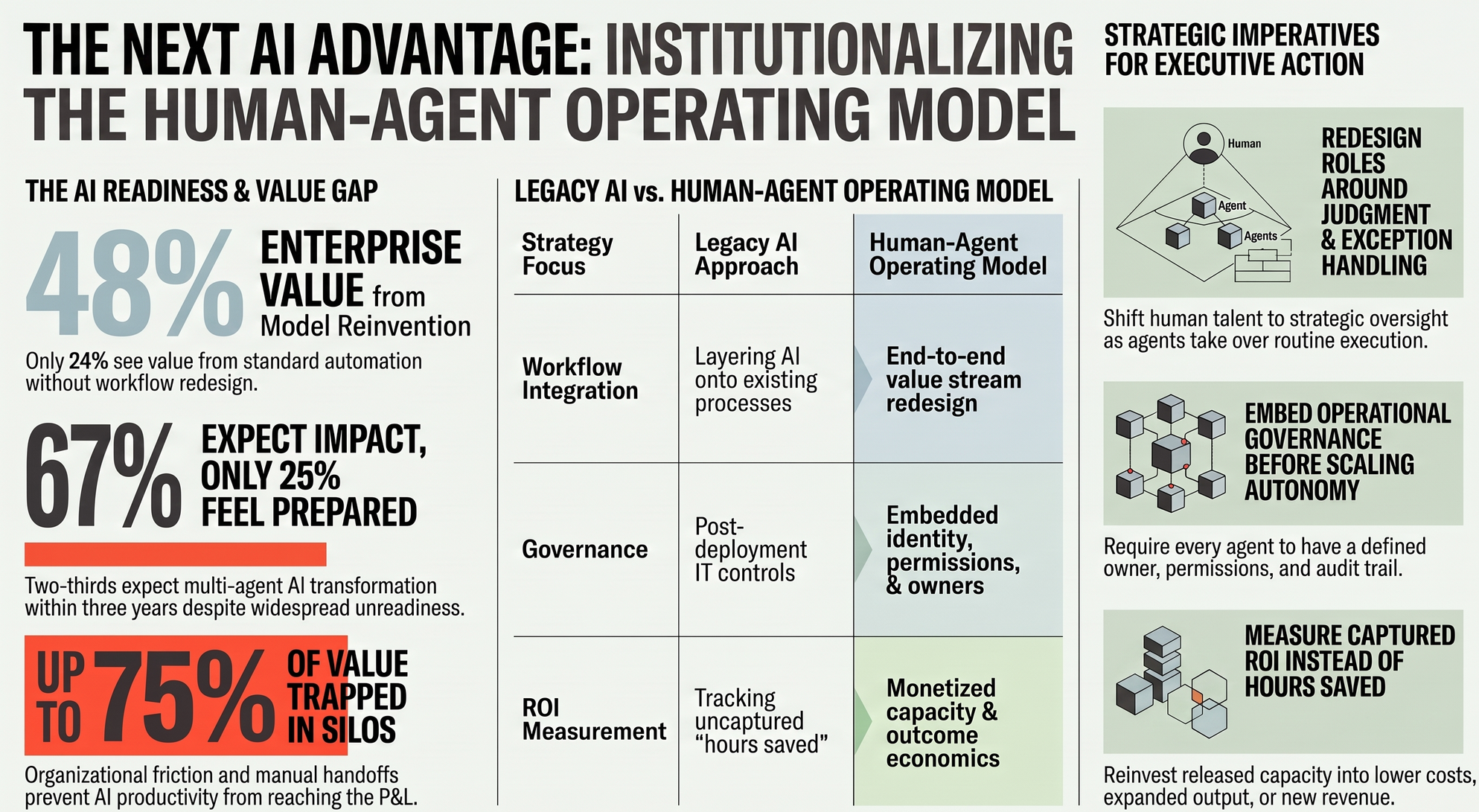
- Operating-model redesign is becoming the value divide. McKinsey reports that 48% of leaders in its AI “reinvention” group see meaningful enterprise value, compared with 24% in automation and 13% in enablement.
- Organizational readiness is lagging technological capability. Deloitte finds that two-thirds of surveyed senior managers expect multi-agent AI to materially reshape work within two to three years, while only about one-quarter believe their processes or workforce are prepared.
- The value opportunity increasingly sits across functions. EY-Parthenon estimates that as much as 70–75% of potential value can remain trapped between organizational silos.
- AI productivity does not automatically become financial value. Leading firms increasingly distinguish between capacity created, capacity captured and value monetized.
- Governance must scale with autonomy. Agent identity, permissions, human ownership, escalation rules and auditability are moving from technology controls into core operating-model design.
Table of Contents
- Technology Potential & Capabilities From AI tools to enterprise execution: how orchestration, permissions, agent identity and workflow architecture determine whether autonomous systems can operate reliably at scale.
- Human Resources & Skills Development Redesigning work around human advantage: why judgment, exception management, accountability and relationship skills become more important as agents absorb routine execution.
- Business Model Transformation Moving from functions to value streams: how human-agent workflows can reduce coordination friction, accelerate decisions and reshape organizational structures around business outcomes.
- Investment & Return on Investment Turning productivity into financial value: why executives need to move beyond hours saved and measure cost per outcome, captured capacity, revenue impact and full agent economics.
- Industry Applications Operationalizing the model in real workflows: what banking, HR and industrial use cases reveal about autonomy, human oversight, exception handling and scalable performance metrics.
- Cross-Article Strategic Synthesis Consensus map, strategic tensions and the executive agenda across the eight firms.
The competitive issue is not access to AI agents. That capability is becoming increasingly available.
The differentiator is the operating model around them.
Organizations that clarify decision rights, redesign workflows and establish governance early can increase autonomy as evidence improves. Organizations that layer agents onto fragmented processes risk accelerating the same handoffs, exceptions and accountability gaps that already constrain performance.
For executives, the next phase of AI strategy is therefore an organizational design decision: operationalize where agents should act, institutionalize where people must decide, and make accountability visible across both.
Technology Potential & Capabilities
From AI tools to an execution layer.
Human-Agent Operating Model — A Human-Agent Operating Model defines how people and AI agents divide work, make decisions, exchange context, escalate exceptions and remain accountable for business outcomes. It covers more than technology. It includes workflows, permissions, governance, skills, performance metrics and decision rights.
Agent orchestration — The coordination layer that assigns activities across agents, people and enterprise systems while enforcing permissions, controls and escalation paths.
Strategic Core
The technology opportunity is moving beyond copilots toward AI systems that can coordinate workflows across functions. But scaling autonomy requires a corresponding operating architecture. EY-Parthenon proposes a seven-layer agentic-enterprise model spanning outcomes, decisions, workflows, agent orchestration, enterprise context and infrastructure. Humans remain embedded where judgment, accountability, ethics or regulatory oversight are required. PwC adds a critical control requirement: every agent needs identity, permissions, an accountable owner, auditable activity and explicit autonomy boundaries.
The implication is practical. Enterprises should not measure technical progress primarily by the number of agents deployed. They should measure whether agents can execute within governed workflows with reliable context, predictable exception handling and traceable decisions.
Strategic Insights
The largest opportunity may sit between functions rather than inside them. EY-Parthenon estimates that as much as 70–75% of value potential can be trapped between organizational silos, where coordination delays, approval latency, rework and fragmented accountability reduce performance.
Yet readiness remains weak. Accenture reports that only 3% of surveyed UK organizations are fully prepared for advanced agentic AI, despite estimating that 82% of working hours could potentially be enhanced by AI. Only 23% of employees in its research had seen major processes redesigned around AI.
This gap matters because agentic systems magnify process design. A fragmented workflow does not become strategically better simply because it executes faster.
- Map the end-to-end workflow before selecting agent technology.
- Institutionalize agent identity, permissions, ownership and escalation controls before increasing autonomy.
- Measure workflow performance, not agent activity.
Where would greater agent autonomy improve an end-to-end business outcome today—and where must human judgment remain explicit?
Human Resources & Skills Development
Redesign work around judgment.
Cognitive skills — Capabilities—analysis, judgment, synthesis, communication or execution—that can be assigned to people, AI agents or a combination of both.
Purposeful friction — Deliberately inserting human review at decisions involving ambiguity, material risk or consequential trade-offs rather than requiring human approval at every process step.
Strategic Core
The workforce question is becoming less about which jobs disappear and more about how tasks and decision rights are redistributed. Forrester recommends treating AI agents as cognitive capabilities rather than simply “digital employees.” Work can then be allocated dynamically to humans, agents or hybrid teams according to proficiency, availability, cost, policy and governance.
Deloitte reaches a complementary conclusion from the human side: as routine coordination and synthesis become automated, scarce human value shifts toward judgment, resilience, relationships, exception handling and consequential decision-making.
The leadership requirement is therefore job redesign, not simply reskilling.
Strategic Insights
Workforce preparedness trails expected technology adoption. Deloitte found that 47% of 1,700 respondents in an informal global webinar poll identified judgment as the most important behavior in the AI era. Its TrustID research also found that workers reporting high organizational trust were 3.8 times as likely to use agentic technology.
That makes trust an operating variable rather than a communications issue. Organizations need visible boundaries around what agents do, where people remain accountable and how employee contribution changes.
PwC recommends staged autonomy: reduce human intervention as agent performance and trust improve, while tracking cycle time, cost-to-serve, decision speed, risk reduction and redeployed capacity.
- Redesign roles around judgment, exceptions and outcomes rather than preserving legacy task lists.
- Build workforce planning around capabilities, not static job descriptions.
- Increase autonomy progressively as performance evidence strengthens.
Which human capabilities become more valuable—not less—when agents take over routine execution in your organization?
Business Model Transformation
Organize around value, not functions.
Enterprise value stream — An end-to-end sequence of decisions and activities that produces a business outcome across multiple functions—for example order-to-cash, concept-to-launch or incident-to-resolution.
AI-first operating model — Redesigns these workflows around the capabilities of humans and AI instead of adding AI tools to an unchanged organizational structure.
Strategic Core
The most consequential shift is from optimizing isolated functions to redesigning end-to-end value creation. McKinsey & Company finds that advanced organizations increasingly organize cross-functional teams around products, customer journeys and processes, with accountability closer to where value is created. They standardize workflows, clarify decision rights and redeploy skills dynamically.
EY-Parthenon makes the economic case for horizontal redesign: enterprise value travels across functions even when organizational structures, systems and KPIs remain vertical.
The strategic prize is lower coordination cost and faster movement from information to decision to action.
Strategic Insights
The quantitative evidence is increasingly material. In an automotive transformation assessment, EY-Parthenon identified nearly USD 2 billion associated with enterprise value streams. It also found that 15–25% of effort in one warranty-management process was consumed by internal coordination rather than direct problem solving.
A global banking case from Boston Consulting Group targets automation of 30–50% of workflows, releasing approximately three million hours of human capacity, equivalent to about 1,700 FTEs, while projecting full payback within two years and a 150% five-year ROI.
Boston Consulting Group summarizes its transformation experience as roughly 30% technology and 70% people and organization.
- Organize AI transformation around material value streams, not departmental use-case inventories.
- Push accountability closer to business outcomes.
- Treat workforce redesign as part of the business case.
Which business outcome is currently constrained more by coordination and handoffs than by employee productivity itself?
Investment & Return on Investment
Measure captured value, not hours saved.
Agent economics — Measures the full cost and economic output of AI agents. It extends beyond token or software costs to infrastructure, integration, governance, human supervision, failure handling, change management and operational support.
AI FinOps — Applies continuous financial discipline to AI investments: measure cost, value and utilization; then scale, redesign or stop deployments according to evidence.
Strategic Core
The ROI discussion is becoming more rigorous. EY distinguishes productivity that is created, captured and monetized. Employee time released by agents is only potential value until management converts that capacity into lower cost, higher output or new revenue. It recommends evaluating AI against its full enterprise cost stack and assigning clear executive ownership for investment, captured value and scaling decisions.
Bain & Company similarly advocates a self-funding investment discipline: capture technology and productivity savings, then reinvest selectively where a clear business case exists.
Strategic Insights
The available benchmarks illustrate why portfolio discipline matters. Bain & Company cites documented 10–20% cloud infrastructure savings, 10–30% reductions in software and maintenance costs, 20–30% faster software delivery, and productivity improvements reaching 40% in some customer-service and IT operations contexts. These figures describe specific applications and should not be treated as universal enterprise returns.
EY models a “payback frontier” showing combinations of cost reduction and growth required to generate a 12% return on the full AI cost stack. The analysis is explicitly scenario-based, not a forecast, and demonstrates how sensitive AI economics are to assumptions about cost recovery and realized productivity.
The board-level implication is straightforward: AI needs investment governance comparable to other strategic capital portfolios.
- Replace “hours saved” with monetized outcome measures.
- Track the full cost per business outcome. Include model usage, infrastructure, integration, governance, human review, exceptions and ongoing support.
- Scale AI investments through portfolio discipline.
When your organization reports AI productivity gains, can finance show where those gains appear in cost, throughput, revenue or working capacity?
Industry Applications
The operating model becomes visible in the workflow.
Agentic-first workflow — Starts with the desired business outcome and redesigns the process around the capabilities of people and agents before technology is selected. It defines decision rights, orchestration, controls, exception paths and performance metrics from the outset.
Strategic Core
Industry applications show that the Human-Agent Operating Model is most valuable where workflows combine high transaction volumes with judgment, regulation and cross-functional handoffs.
In banking, the Boston Consulting Group case demonstrates how agents can absorb routine HR and operational execution while employees move toward strategy, orchestration and governance roles.
In HR, PwC recommends designing agentic-first workflows before selecting platforms, then increasing autonomy in stages as performance evidence and trust improve.
In automotive operations, EY-Parthenon highlights coordination-heavy workflows as targets for cross-functional orchestration.
Strategic Insights
The use cases point toward a more disciplined performance model. Rather than measuring “AI adoption,” executives can track straight-through processing rate, cycle time, exception rate, first-pass QA, escalation frequency, cost per case and capacity redeployment.
PwC explicitly recommends outcome measures such as cycle time, cost-to-serve, decision speed, risk reduction and capacity redeployment rather than vague productivity claims.
The underlying pattern is transferable across sectors. High-value agentic workflows tend to combine repeatable execution with clearly defined exceptions. Humans remain concentrated at points of ambiguity, regulatory responsibility, customer sensitivity or material risk.
- Select workflows where outcomes and exception paths can be measured clearly.
- Preserve human intervention where judgment materially changes risk or outcomes. The objective is not zero-touch processing at any cost; it is economically efficient, auditable allocation of work.
- Scale proven workflow patterns across adjacent value streams.
Which operating metric would tell you that a human-agent workflow is genuinely improving the business rather than simply automating more activity?
Cross-Article Strategic Synthesis
Where the leading advisory firms agree — and where their perspectives diverge.
Strategic Consensus Map
- Where to start. Redesign meaningful workflows rather than accumulate isolated AI use cases.
Business implication: Prioritize end-to-end value streams with measurable economic outcomes. - Human role. Human value shifts toward judgment, accountability, relationships and exception management.
Business implication: Redesign roles and skills alongside process automation. - Agent autonomy. Autonomy must be bounded by identity, permissions, ownership, escalation and auditability.
Business implication: Governance becomes embedded in runtime operations. - Organization design. Legacy functional boundaries can constrain AI value.
Business implication: Cross-functional accountability becomes increasingly important. - Measurement. Activity and hours saved are insufficient evidence of value.
Business implication: Track cycle time, quality, cost per outcome, risk, revenue and monetized capacity. - Scaling. Technology alone does not determine performance.
Business implication: Architecture, workflows, trust, talent and incentives need to change together.
This convergence is visible across McKinsey & Company, Boston Consulting Group, EY-Parthenon, PwC and Deloitte.
Strategic Tensions
-
Agents as workers—or as capabilities?
PwC uses the language of digital workforce counterparts because it creates clear governance analogues: agents need identity, access rights, owners and auditable activity.
Forrester takes a deliberately different position. It argues that agents should be treated as cognitive capabilities that can be composed with human skills rather than anthropomorphized as employees.
These perspectives are compatible operationally. Govern agents as accountable operational entities, but design work around capabilities rather than artificial job titles.
-
Maximum autonomy—or economically optimal autonomy?
None of the stronger sources treats maximum autonomy as the objective. PwC emphasizes scalable human accountability and engineered supervision. Deloitte recommends placing human intervention where genuine ambiguity, exceptions or consequential trade-offs remain.
The more defensible objective is risk-adjusted autonomy: increase agent authority where reliability and economics support it, while retaining human control where failure costs or accountability requirements remain material.
-
Efficiency—or growth?
EY challenges business cases built predominantly around theoretical labor savings. Its analysis argues that sustainable returns at scale increasingly depend on converting productivity into additional output and growth as well as cost reduction.
Boston Consulting Group provides a company-level illustration of how released capacity can be linked to an explicit ROI program.
The executive decision is therefore not simply whether AI reduces work. It is what management intends to do with the capacity it releases.
The Executive Agenda
The Human-Agent Operating Model turns agentic AI from a technology deployment into an organizational design decision.
The practical sequence is increasingly clear:
- Define the business outcome and its baseline economics.
- Map the full workflow and identify coordination friction.
- Allocate tasks and decisions between people and agents.
- Define permissions, ownership, escalation and audit requirements.
- Build the context and orchestration layer required for reliable execution.
- Redesign human roles around judgment, exceptions and higher-value contribution.
- Measure cycle time, straight-through processing, quality, exception rates and cost per outcome.
- Scale only when productivity is captured as financial or strategic value.
The next AI advantage is therefore unlikely to come from deploying the largest number of agents. It will come from designing an organization in which human judgment and machine execution reinforce each other—and where accountability remains visible as autonomy increases.
Executive Reflection
If AI agents became a material source of execution capacity in your organization tomorrow, would your operating model tell them—and your people—who decides, who acts and who remains accountable?
Sources & References
Primary sources
- McKinsey & Company — "The Key to AI Value Is Hiding in Plain Sight: Your Operating Model · Sept 2026" https://www.mckinsey.com/capabilities/people-and-organization/our-insights/the-key-to-ai-value-is-hiding-in-plain-sight-your-operating-model
- BCG — "Design Your Company for AI, Not AI for Your Company · Apr 2026" https://www.bcg.com/publications/2026/design-your-company-for-ai-not-ai-for-your-company
- Deloitte Insights — "How Will AI Agents Fit into the Human Workplace? · Sept 2026" https://www.deloitte.com/us/en/insights/topics/technology-management/ai-agents-human-workplace.html
- PwC — "AI Agents as Workforce Counterparts — What Governance Should Look Like (Trust and Safety Outlook 2026) · Jul 2026" https://www.pwc.com/us/en/industries/tmt/library/trust-and-safety-outlook/ai-agents-workforce-governance.html
- PwC — "How Forward-Looking CHROs Are Redesigning HR with Agentic AI · Sept 2026" https://www.pwc.com/us/en/services/ai/chro-agentic-ai-hr-transformation.html
- EY-Parthenon — "How Agentic AI Can Help Unlock Enterprise Value at Scale · Jun 2026" https://www.ey.com/en_uk/insights/strategy/how-agentic-ai-can-help-unlock-enterprise-value-at-scale
- EY — "Agentic AI ROI: Can AI Pay for Itself? · Sept 2026" https://www.ey.com/en_us/insights/ai/agentic-ai-return-on-investment
- Bain & Company — "FinOps for AI: From Managing Costs to Maximizing Value · Sept 2026" https://www.bain.com/insights/finops-for-ai-from-managing-costs-to-maximizing-value/
- Accenture — "Generating Impact: Harnessing Frontier AI Capabilities to Unlock Frontline Productivity and Growth in the UK · Apr 2026" https://www.accenture.com/en-gb/insights/ai-data/generating-impact
- Forrester — "The Agentic Age Needs a Cognitive Operating Model" https://www.forrester.com/blogs/the-agentic-age-needs-a-cognitive-operating-model/